
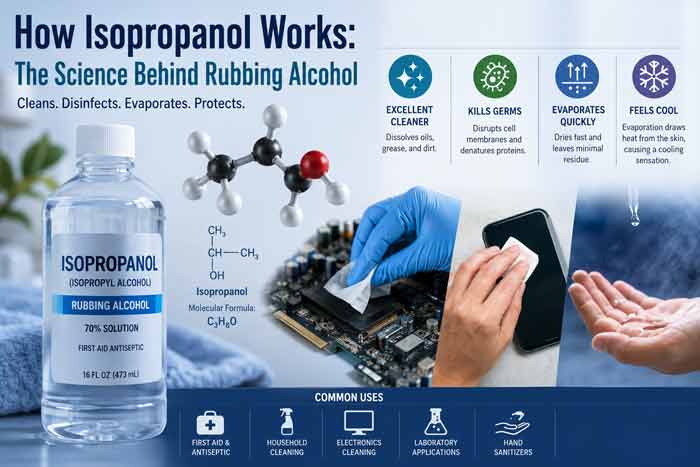
Isopropanol or rubbing alcohol is one of the most common chemicals found in homes, hospitals, laboratories, and workplaces around the world.
Almost everyone has used rubbing alcohol at some point in their life.
You may have seen it in a first-aid kit, used it to clean a smartphone screen, watched a nurse wipe your skin before an injection, or noticed it as an ingredient in hand sanitizers and disinfectant wipes.
Yet despite its widespread use, most people know very little about what rubbing alcohol actually is or why it works so well.
In this article, we will explore how isopropanol works, what makes it different from other types of alcohol, why it evaporates so quickly, how it destroys germs, and why it has become one of the most useful chemicals found in homes and industries around the world.
Now, let’s begin:
What Exactly Is Isopropanol?
Before we can understand how isopropanol works, we first need to understand what it is.
Isopropanol, also called isopropyl alcohol or simply IPA, is a clear, colorless liquid with a strong, distinctive smell.
It belongs to a family of chemicals known as alcohols.
When many people hear the word “alcohol,” they immediately think of alcoholic beverages.
However, the word alcohol refers to a large group of chemical compounds, and not all of them are safe to drink.
Isopropanol is one of these alcohols you must not drink.
The chemical formula of isopropanol is:
C3H8O
This formula tells chemists that each molecule contains:
- 3 carbon atoms,
- 8 hydrogen atoms,
- and 1 oxygen atom.
Although that may seem like a simple arrangement of atoms, it gives isopropanol a unique set of properties that make it useful for cleaning, disinfecting, and dissolving substances.
Isopropanol vs. Drinking Alcohol
One of the most common misconceptions about the alcohol group of chemicals is that rubbing alcohol and drinking alcohol are basically the same thing.
They are not.
The alcohol found in alcoholic beverages is called ethanol.
While ethanol is safe to consume in controlled amounts, isopropanol is not.
Both substances belong to the alcohol family and share some similar properties, such as:
- rapid evaporation,
- flammability,
- and the ability to kill germs.
However, the human body processes them very differently.
Isopropanol can be toxic if swallowed and should never be consumed.
Think of ethanol and isopropanol as chemical cousins rather than identical twins.
They may look similar, but their effects on the body are very different.
Why is Isopropanol Called “Rubbing Alcohol”?
The term rubbing alcohol comes from its historical use as a topical antiseptic and muscle rub.
For many years, people applied diluted isopropanol to the skin:
- to clean minor cuts,
- to disinfect surfaces,
- and sometimes as part of massage treatments for sore muscles.
Over time, the name “rubbing alcohol” became more common than the chemical name itself.
Today, when most people buy rubbing alcohol from a pharmacy or supermarket, they are usually purchasing a diluted solution of isopropyl alcohol mixed with water.
What Does Isopropanol Look Like?
At first glance, isopropyl alcohol looks almost exactly like water.
It is:
- clear,
- colorless,
- and free-flowing.
But there are some noticeable differences.
Unlike water, isopropyl alcohol has:
- a sharp odor,
- faster evaporation,
- and stronger cleaning power.
If you’ve ever opened a bottle of rubbing alcohol, you’ve probably noticed the strong smell immediately.
That smell comes from alcohol molecules quickly escaping into the air.
This rapid evaporation is one of the reasons isopropanol is so useful.
Why Is Isopropanol So Useful?
The popularity of IPA comes from the fact that it combines several useful characteristics in a single liquid:
- It evaporates quickly.
- It dissolves oils and grease.
- It mixes easily with water.
- It kills many bacteria and viruses.
- It leaves little residue behind.
- It can clean delicate electronic components.
Few household chemicals can do all these things at once.
That is why isopropyl alcohol appears in:
- hospitals,
- laboratories,
- electronic repair shops,
- manufacturing facilities,
- and homes around the world.
The Chemistry of Isopropyl Alcohol
Now that we know what isopropanol is, let’s look at what makes it behave the way it does.
The secret lies in its molecular structure.
Scientists often say that a chemical’s behavior depends on how its atoms are arranged, which is its chemical structure.
Isopropanol is a perfect example of this principle.
As stated earlier, its chemical formula is:
C3H8O
While that formula tells us what atoms are present, it does not tell the whole story. What really matters is how those atoms are connected.
Isopropanol Molecular Structure
The molecular structure of isopropanol is shown in the diagram below, which shows both the water loving end and the part that allows it to dissolve in oil:
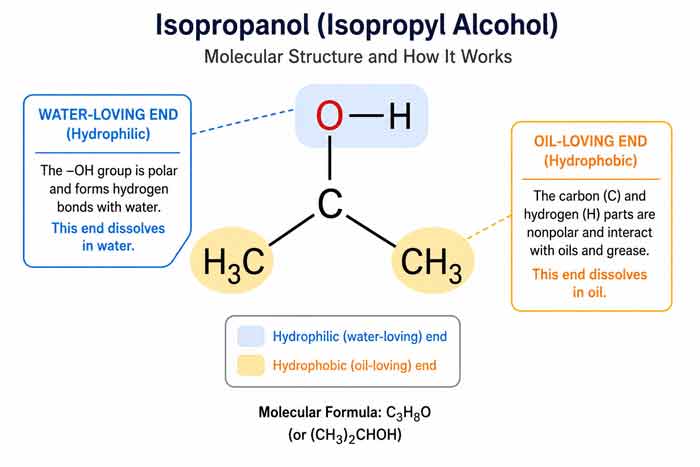
One end of the isopropanol molecule is attracted to water, while another part is attracted to oils and grease.
This unusual combination makes IPA a kind of chemical “middleman” that can interact with both water-based and oil-based substances.
That is one reason it is such an effective cleaner.
Why Isopropanol Mixes With Water
One part of the isopropanol molecule contains oxygen as you can see from its chemical structure above.
That oxygen helps the molecule to interact with water.
As a result:
- water and isopropanol mix easily,
- they form a uniform solution,
- and they can work together during cleaning and disinfecting.
This property is extremely important because many germs exist in moist environments where water is present, making isopropanol useful in taking them out.
Why Isopropanol Dissolves Oils and Grease
At the same time, another part of the isopropanol molecule contains carbon and hydrogen atoms (again, see the chemical structure above).
These portions interact well with:
- oils,
- grease,
- skin oils,
- adhesives,
- and many organic residues.
This gives isopropyl alcohol an advantage over plain water.
Water can wash away dirt and some soluble substances.
But greasy fingerprints?
Sticky residues?
Many oily contaminants?
Water cannot handle those situations; they often require a solvent like isopropyl alcohol.
Why Isopropanol Evaporates So Quickly
One of the first things people notice about rubbing alcohol is that it disappears fast.
Pour a few drops on a surface and watch.
Within seconds, much of it is gone.
Why?
The answer involves a process called evaporation.
What Is Evaporation?
Evaporation happens when molecules escape from a liquid and enter the air as a gas.
Even at room temperature, molecules inside a liquid are constantly moving.
Some move fast enough to break free from the liquid’s surface.
When enough molecules escape, the liquid gradually disappears.
This happens with:
- water,
- perfume,
- gasoline,
- and alcohol.
But not all liquids evaporate at the same speed.
Why Isopropanol Evaporates Faster Than Water
Compared with water, isopropanol molecules are held together less strongly.
That means they require less energy to escape into the air.
As a result:
- isopropanol evaporates faster,
- dries surfaces more quickly,
- and leaves less moisture behind.
This is one of the main reasons it is used for cleaning electronics.
Imagine cleaning a computer motherboard with water.
Water could remain trapped in tiny spaces and potentially cause damage.
IPA evaporates much faster, reducing that risk.
Why Fast Evaporation Is Useful
Rapid evaporation provides several benefits, including:
- Faster drying
Surfaces become usable sooner.
- Less residue
There is less chance of leaving behind moisture.
- Better cleaning
Dissolved oils and contaminants are carried away as the liquid evaporates.
- Electronics safety
Quick drying reduces exposure to moisture.
This combination of cleaning power and fast evaporation is one reason technicians love using isopropanol.
Uses of Isopropanol in Cleaning Electronics
One of the most interesting uses of isopropanol is electronics cleaning.
If you’ve ever watched someone repair a computer, smartphone, or gaming console, you’ve probably seen a bottle of isopropyl alcohol nearby.
Why?
Because electronics and water do not get along very well.
Why Water Can Be a Problem
Water can remain trapped inside electronic devices.
If moisture stays in the wrong place, it may:
- interfere with electrical connections,
- promote corrosion,
- or damage sensitive components.
Even a tiny amount of trapped moisture can create problems.
Why Technicians Prefer Isopropanol
Isopropanol offers several advantages:
- Fast evaporation
It dries quickly.
- Low residue
It leaves little behind.
- Oil removal
It dissolves grease and contaminants.
- Precision cleaning
It can reach small spaces and delicate components.
Because of these qualities, technicians often use high-purity isopropanol when cleaning:
- circuit boards,
- processors,
- connectors,
- cooling systems,
- and electronic contacts.
Why High-Purity Alcohol Is Often Used
For electronics cleaning, higher concentrations such as:
- 91%,
- 95%,
- or 99%
are often preferred.
These contain less water and dry even faster.
This reduces the chance of moisture remaining on delicate components.
Uses of Isopropanol in Removing Thermal Paste
Another common use of IPA is in removing old thermal paste from computer processors.
Thermal paste helps transfer heat between a processor and its cooling system.
When upgrading or repairing a computer, technicians often remove the old paste.
Isopropanol works well because it:
- dissolves residue,
- evaporates quickly,
- and leaves a clean surface ready for fresh paste.
Why It Leaves Little Residue
One reason people love using IPA is that it tends to leave very little behind.
Many cleaning products contain:
- soaps,
- fragrances,
- waxes,
- or other additives.
These substances can leave films or streaks.
Pure isopropanol largely evaporates into the air.
As a result:
- surfaces dry quickly,
- residue is minimized,
- and cleaning becomes more efficient.
This property is especially valuable when cleaning sensitive equipment.
Uses of Isopropanol in Hospitals
Before injections, nurses often wipe the skin with isopropyl alcohol.
Part of the cooling sensation patients notice comes from evaporation.
The alcohol disinfects the area while simultaneously creating a brief cooling effect.
Many people associate that cool feeling with cleanliness because they have experienced it so often in healthcare settings.
How Isopropanol Kills Germs
Perhaps the most famous use of rubbing alcohol is disinfection.
People use it to:
- clean surfaces,
- sanitize hands,
- disinfect medical equipment,
- and reduce the spread of germs.
But how does it actually kill microorganisms?
The answer involves chemistry at the cellular level.
What Are Germs?
The word “germs” is a general term people use for microorganisms that can cause disease.
These include:
- bacteria,
- viruses,
- and some fungi.
Although these organisms differ greatly, many share one weakness:
They depend on delicate biological structures to survive.
When those structures are damaged, the organism can no longer function properly.
The Protective Outer Layer
Many bacteria and viruses have protective outer layers.
These layers help:
- maintain structure,
- regulate what enters and leaves,
- and protect important internal components.
Think of these outer layers as the walls of a house.
If the walls collapse, the house can no longer function as intended.
How Isopropanol Attacks Microorganisms
Isopropyl alcohol is especially effective because it can disrupt these protective structures.
When alcohol comes into contact with many bacteria and viruses, it can:
- Damage cell membranes
The outer barriers begin to break down.
- Disrupt proteins
Important proteins lose their normal shape and function.
- Interfere with vital processes
The microorganism can no longer carry out essential activities.
Without intact membranes and working proteins, many microbes quickly die or become inactive.
Why Proteins Matter
Proteins are the molecular machines of life.
They perform countless jobs inside living organisms.
Examples include:
- building structures,
- transporting materials,
- producing energy,
- and controlling chemical reactions.
Isopropyl alcohol can cause proteins to unfold and lose their normal shape.
When this happens, the proteins stop working properly.
Imagine removing several key parts from a machine.
Even if the machine still exists, it can no longer operate.
Why 70% Alcohol Often Works Better Than 99% in Killing Germs
This fact surprises many people.
Most people assume stronger alcohol automatically means better disinfection.
In reality, solutions containing about 70% isopropanol are often more effective than nearly pure alcohol.
Why?
Because water plays an important role in killing germs.
The water helps:
- alcohol penetrate germ cells more effectively,
- slow evaporation slightly,
- increase contact time,
- and improve protein disruption.
If alcohol evaporates too quickly, it may not have enough time to do its job.
This is why many disinfectants contain a carefully balanced mixture of alcohol and water.
Why Hand Sanitizers Use Alcohol
Many hand sanitizers rely on isopropyl alcohol for the same reason.
Alcohol can rapidly reduce the number of microorganisms on the skin.
Its effectiveness, combined with quick drying, makes it ideal for situations where soap and water are not immediately available.
However, sanitizers work best on relatively clean hands.
Heavy dirt or grease can reduce effectiveness because they may shield microorganisms from direct contact with the alcohol.
Isopropanol in First Aid Kits
For decades, rubbing alcohol has been associated with home first-aid kits.
People often use it for:
- cleaning tweezers,
- disinfecting thermometers,
- sanitizing small tools,
- and cleaning intact skin.
However, modern wound care has evolved.
Different Concentrations of Isopropanol and Their Uses
Not all rubbing alcohol products are the same in concentration and uses.
If you’ve looked at bottles in a store, you’ve probably noticed different percentages printed on the label.
Common concentrations include:
- 50%
- 70%
- 91%
- 99%
These percentages tell you how much of the liquid is isopropanol and how much is water.
50% Isopropanol
This concentration contains roughly equal amounts of:
- alcohol,
- and water.
It is often used for:
- gentle cleaning,
- light disinfecting,
- and some household applications.
70% Isopropanol
This is one of the most common concentrations.
It is widely used because it offers a balance between:
- disinfecting power,
- evaporation rate,
- and effectiveness.
As discussed earlier, the added water helps improve germ-killing performance.
For many disinfecting purposes, 70% is considered ideal.
91% Isopropanol
This concentration contains less water and more alcohol.
Benefits include:
- faster evaporation,
- stronger solvent action,
- and better cleaning of electronics.
It is popular among technicians and hobbyists.
99% Isopropanol
This is nearly pure isopropanol.
It is commonly used in:
- laboratories,
- electronics manufacturing,
- industrial applications,
- and precision cleaning.
Because it evaporates extremely quickly, it is often chosen when minimal moisture is important.
Why Isopropanol Feels Cold on Your Skin
Another curious thing happens when you apply rubbing alcohol to your skin.
It feels cold.
Sometimes surprisingly cold.
Yet the liquid itself may be at room temperature.
So, where does that cooling sensation come from?
The answer lies in the same process we just discussed: evaporation.
The cooling feeling comes from something much more interesting: evaporative cooling.
What Is Evaporative Cooling?
Evaporative cooling occurs when a liquid changes into a gas.
To make this transition, molecules need energy.
Where do they get that energy?
In the case of rubbing alcohol on your skin, they take it from the surface of your skin itself.
As the alcohol evaporates:
- energy leaves your skin,
- heat is carried away,
- and your skin temperature drops slightly.
Your nerves detect this temperature change and send a signal to your brain.
The result?
You feel cold.
Think About Sweat
The same thing happens when you sweat.
Sweat sits on your skin and gradually evaporates.
As it evaporates:
- heat leaves your body,
- your skin cools down,
- and you feel refreshed.
Rubbing alcohol simply evaporates much faster than sweat.
Because the evaporation happens quickly, the cooling sensation can feel stronger.
Why Isopropanol Feels Colder Than Water
Water also evaporates and can cool the skin.
But water evaporates much more slowly than isopropanol.
Since isopropanol escapes into the air rapidly:
- it removes heat faster,
- cooling occurs more quickly,
- and the sensation becomes more noticeable.
This is why rubbing alcohol often feels dramatically cooler than a splash of water.
Everyday Products That Contain Isopropanol
Many people use isopropanol without even realizing it.
It appears in a surprising variety of products, including.
Household Cleaning Products
Many cleaning solutions contain isopropanol because it:
- cuts through grease,
- removes fingerprints,
- and evaporates quickly.
You may find it in:
- glass cleaners,
- electronic cleaners,
- multipurpose sprays,
- and disinfecting products.
Personal Care Products
Small amounts of isopropanol may appear in certain:
- cosmetics,
- hair products,
- lotions,
- deodorants,
- and beauty products.
In these products, it may help:
- dissolve ingredients,
- improve texture,
- or speed drying.
Disinfectant Wipes
Many disinfectant wipes rely on alcohol to provide rapid cleaning and disinfection.
The alcohol helps:
- dissolve oils,
- remove contaminants,
- and reduce microorganisms on surfaces.
Laboratory and Industrial Products
Outside the home, isopropanol is used in:
- laboratories,
- pharmaceutical manufacturing,
- electronics production,
- automotive industries,
- and research facilities.
Its versatility makes it valuable in countless professional settings.
Safety and Risks of Isopropanol
Like many useful chemicals, IPA should be handled responsibly.
Used properly, it is extremely valuable.
Used carelessly, it can create risks.
It Is Flammable
One of the most important safety facts about isopropanol is that it can catch fire.
Its vapors are flammable.
This is why it should be kept away from:
- open flames,
- sparks,
- and high heat sources.
Proper Ventilation Matters
Because isopropanol evaporates easily, large amounts can produce significant vapor.
Using it in well-ventilated areas helps prevent excessive vapor buildup.
Keep It Away From Children and Pets
Like many household chemicals, rubbing alcohol should be stored safely.
It is not a beverage and should never be consumed.
Secure storage helps prevent accidental exposure.
Fun Experiments You Can Try at Home
One of the best ways to understand chemistry is to observe it yourself.
Here are a few simple demonstrations that highlight the unique properties of isopropanol.
Experiment 1: Water vs. Alcohol Evaporation
Place:
- a few drops of water,
- and a few drops of isopropanol
on separate plates.
Observe which disappears first.
You’ll likely notice that the alcohol evaporates much faster.
Experiment 2: The Cooling Effect Test
Place a small amount of water on one hand and a small amount of rubbing alcohol on the other.
Notice the difference in cooling sensation.
This demonstrates evaporative cooling in action.
Experiment 3: Fingerprint Removal
Touch a clean glass surface.
Observe the fingerprint.
Then clean it using isopropanol and compare the result.
This demonstrates its ability to dissolve skin oils.
Conclusion
Isopropanol may seem like an ordinary bottle sitting in a medicine cabinet, but it is actually a remarkable example of chemistry at work.
Its molecular structure allows it to:
- dissolve oils,
- mix with water,
- evaporate rapidly,
- clean surfaces,
- and destroy many microorganisms.
These properties have made it indispensable in healthcare, electronics, laboratories, manufacturing, and everyday household use.
From the cool sensation on your skin to the disinfecting power of an alcohol wipe, the effects of isopropyl alcohol are all rooted in chemistry.
Every time you use rubbing alcohol, you are witnessing molecules interacting with heat, water, oils, germs, and surfaces in ways that make modern cleaning and disinfection possible.
The next time you open a bottle of rubbing alcohol, remember: you’re not just using a household product – you’re using one of the most versatile and fascinating chemicals in everyday life.