
Although most people have never heard of Dimethyl Sulfoxide, better known as DMSO, scientists have been fascinated by it for decades.
It is widely used in laboratories, pharmaceutical research, biotechnology, and manufacturing.
What makes it especially remarkable is its ability to dissolve a huge variety of substances and move through certain biological membranes more easily than many other chemicals.
To chemists, DMSO is much more than a liquid in a bottle. It is a powerful tool that helps make research, drug development, and industrial processes possible.
Its unusual combination of properties has made it one of the most widely studied solvents in modern science.
In this article, we’ll explore what DMSO is, how it works, why scientists find it so useful, and how this little-known chemical quietly contributes to many aspects of modern life.
Now, let’s go:
What is DMSO?
DMSO stands for Dimethyl Sulfoxide, an organic compound that contains carbon, hydrogen, sulfur, and oxygen.
Chemical Formula of DMSO
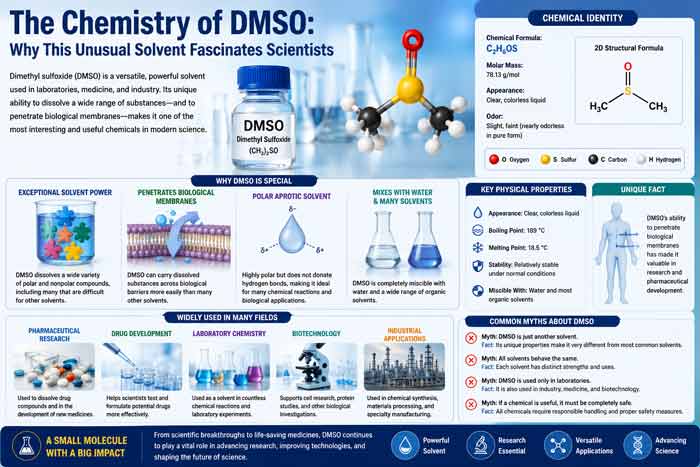
The chemical formula of Dimethyl Sulfoxide is C2H6OS
At room temperature, DMSO is typically:
- Clear
- Colorless
- Liquid
- Highly soluble
- Relatively stable.
Although it may look like water, its chemical behavior is very different.
Where Does DMSO Come From?
Interestingly, DMSO was originally derived from substances found in wood processing.
Today, it is produced industrially and used in laboratories, manufacturing facilities, and research institutions around the world.
Understanding the Molecular Structure of DMSO
The unique properties of DMSO come from its molecular structure.
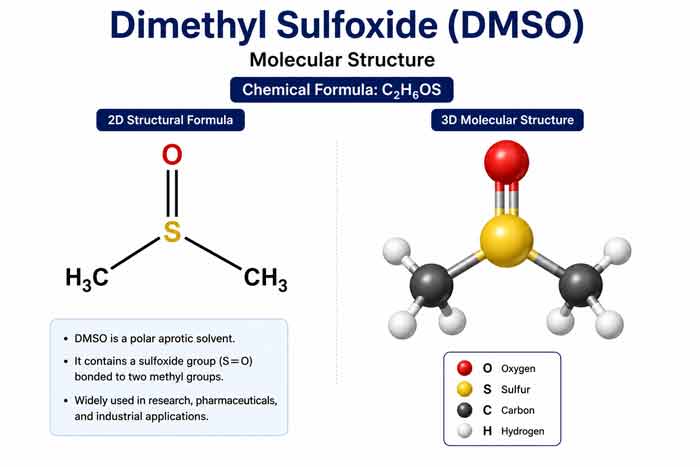
As you can see in the molecular structure of DMSO above, this chemical has a small structure that consists of:
- One sulfur atom
- One oxygen atom
- Two methyl groups (CH3)
While the structure appears simple, it creates a surprisingly versatile chemical.
Why the Structure Matters
The structure is important because it explains the chemistry of DMSO. The sulfur-oxygen bond gives DMSO a strong polarity.
This means parts of the molecule carry slight electrical charges.
As a result, DMSO can interact with many different substances and dissolve compounds that other solvents struggle to handle.
This characteristic is one of the reasons scientists value it so highly.
What is a Solvent?
To understand DMSO, it helps to understand solvents.
A solvent is a substance that dissolves other materials.
Water is the most familiar example.
It dissolves:
- Salt
- Sugar
- Many household substances.
However, water cannot dissolve everything.
Some chemicals dissolve better in organic solvents than water, such as DMSO.
Why DMSO is Such a Powerful Solvent
One of DMSO’s greatest strengths is its ability to dissolve a wide variety of substances.
It Works With Many Types of Compounds
Some solvents are only good at dissolving certain kinds of materials.
DMSO is different, it can dissolve:
- Many organic compounds
- Some inorganic compounds
- Pharmaceutical ingredients
- Polymers
- Research chemicals.
This flexibility makes it extremely useful in both laboratories and industry.
A Helpful Analogy
Imagine a person who speaks many languages and can help different groups communicate.
DMSO often plays a similar role in chemistry. It helps substances interact that might otherwise remain separate.
The Famous Ability of DMSO
Among scientists, one property of DMSO is particularly famous.
It can move through certain biological membranes more readily than many other solvents.
Why this is Interesting
Most substances have difficulty crossing biological barriers, but the DMSO’s molecular structure allows it to interact with membranes in unusual ways.
This property has made DMSO valuable in:
- Biological research
- Pharmaceutical studies
- Laboratory experiments.
Because of this behavior, scientists have studied DMSO extensively for decades.
Properties of Dimethyl Sulfoxide
Dimethyl Sulfoxide shows specific physical and chemical properties that enable chemists and manufacturers to understand how to work with it and use it in making valuable products.
Physical Properties of DMSO
Several physical properties contribute to DMSO’s usefulness. These include:
- Appearance: DMSO is a clear, colorless liquid.
- Solubility: It mixes readily with water and many organic solvents.
- Stability: Under normal conditions, DMSO is relatively stable. This makes it practical for research and industrial applications.
- Boiling Point: DMSO has a relatively high boiling point (189°C (372°F) at standard atmospheric pressure ) compared with many common solvents. This allows it to remain useful in processes involving elevated temperatures.
- Freezing Point: The freezing point of DMSO is 18.5°C (65.3°F). This is an unusual feature that allows DMSO to solidify at relatively moderate temperatures compared with many other solvents. Pure DMSO can sometimes form crystals in cool environments.
Chemical Properties of DMSO
The chemical properties of DMSO are just as important as its physical characteristics. They include:
- Polar Nature
DMSO is highly polar. This helps explain its excellent solvent abilities.
- Polar Aprotic Solvent
Chemists classify DMSO as a polar aprotic solvent. In simple terms, this means it can support many chemical reactions without interfering with them.
- Oxidation and Reduction Chemistry
DMSO can participate in certain oxidation and reduction reactions. These reactions are important in organic chemistry and chemical synthesis.
- Compatibility With Many Chemicals
DMSO works well alongside numerous chemical compounds and reagents. This versatility is another reason it is widely used in research.
Common Uses of DMSO
Because of its unusual properties, DMSO has found applications in many fields, including.
- Scientific Research
Many laboratories use DMSO as a solvent during experiments and chemical analysis.
- Pharmaceutical Development
Drug researchers often use DMSO when studying potential medicines.
Its solvent properties help dissolve compounds that are otherwise difficult to work with.
- Biotechnology
DMSO plays a role in various biological and medical research applications.
- Chemical Manufacturing
Industrial facilities use DMSO in the production of specialty chemicals and materials.
- Materials Science
Researchers developing new materials frequently rely on DMSO because of its broad solvent capabilities.
DMSO in Everyday Life
Most people never purchase DMSO directly. However, they may benefit from products that were developed or manufactured using it.
Examples include:
- Pharmaceutical products
- Research-derived technologies
- Advanced materials
- Certain industrial products.
This makes DMSO another example of chemistry working behind the scenes.
Is DMSO Dangerous?
Like many industrial chemicals, DMSO should be handled responsibly. Its usefulness does not eliminate the need for safety precautions.
Because DMSO can interact with biological tissues more readily than many solvents, researchers and industrial users take appropriate safety measures when working with it.
Common Myths about DMSO
Here are common myths about DMSO and their truths:
Myth #1: DMSO is Just another Solvent
False.
Its unusual combination of solvent power and biological interactions makes it different from many common solvents.
Myth #2: All Solvents Behave the Same Way
False.
Each solvent has unique properties and applications.
Myth #3: DMSO is Only Used in Laboratories
False.
It is also used in pharmaceutical development, biotechnology, and industrial manufacturing.
Myth #4: If a Chemical is Useful, it must Be Completely Safe
False.
All chemicals should be used responsibly and according to appropriate safety guidelines.
Surprising Facts about DMSO
The following are amazing facts about Dimethyl Sulfoxide to boost your knowledge-base:
- DMSO contains sulfur.
- It can dissolve a remarkably wide variety of substances.
- Scientists have studied it for decades.
- It is widely used in pharmaceutical research.
- It can interact with biological membranes more readily than many common solvents.
- It remains one of the most important specialty solvents in modern science.
Why Scientists are Fascinated by DMSO
Chemists appreciate DMSO because it solves problems. When other solvents fail to dissolve a substance, DMSO often succeeds.
When researchers need a stable solvent for complex experiments, DMSO is frequently considered.
Its unique combination of:
- Strong solvent power
- Chemical stability
- Broad compatibility
- Biological relevance
makes it one of the most useful solvents ever developed.
Frequently Asked Questions (FAQs) about DMSO (Dimethyl Sulfoxide)
The following are frequently asked questions about DMSO and their answers:
- What is DMSO?
DMSO, or Dimethyl Sulfoxide, is an organic sulfur-containing compound widely used as a solvent in scientific research, pharmaceutical development, biotechnology, and industrial manufacturing.
Its chemical formula is: C2H6OS
- Why is DMSO considered a special solvent?
DMSO is considered unusual because it can dissolve a remarkably wide variety of substances, including many compounds that are difficult to dissolve in water or other common solvents.
- What does DMSO look like?
Pure DMSO is a clear, colorless liquid. It is relatively stable and has little odor when pure, although some people may notice a slight sulfur-like smell.
- What industries use DMSO?
DMSO is used in:
- Pharmaceutical research
- Biotechnology
- Chemical manufacturing
- Materials science
- Laboratory research
- Specialty chemical production.
- Why do scientists use DMSO in laboratories?
Scientists use DMSO because it can dissolve many research compounds, making it easier to study chemical reactions, biological systems, and potential medicines.
- Can DMSO mix with water?
Yes. DMSO is completely miscible with water, meaning it can mix with water in any proportion without separating into layers.
- What makes DMSO different from water as a solvent?
While water dissolves many everyday substances, DMSO can dissolve a broader range of organic and inorganic compounds. This makes it useful for applications where water is not effective.
- Why are researchers interested in DMSO’s interaction with biological tissues?
DMSO has an unusual ability to move through certain biological membranes more readily than many other solvents. This property has made it a valuable subject of scientific and medical research.
- Is DMSO used in the production of medicines?
Yes. DMSO is widely used during pharmaceutical research and drug development because it can dissolve many drug candidates and assist in laboratory testing and manufacturing processes.
- Why is DMSO important to modern science?
DMSO helps scientists conduct research, develop new medicines, create advanced materials, and perform complex chemical reactions. Its unique combination of solvent power, stability, and versatility has made it one of the most important specialty solvents used in modern laboratories and industries.
Conclusion
Dimethyl sulfoxide may not be a household name, but it has earned a special place in science.
Its remarkable ability to dissolve a wide range of compounds, support chemical reactions, and interact with biological systems has made it indispensable in laboratories, pharmaceutical research, biotechnology, and manufacturing.
While most people will never encounter DMSO directly, its influence can be found in countless scientific discoveries and industrial innovations.
It serves as a reminder that some of the most important chemicals are not the ones we see every day, but the ones quietly helping researchers and manufacturers push the boundaries of what is possible.
For scientists, DMSO is far more than a solvent — it’s one of chemistry’s most versatile and fascinating tools.