
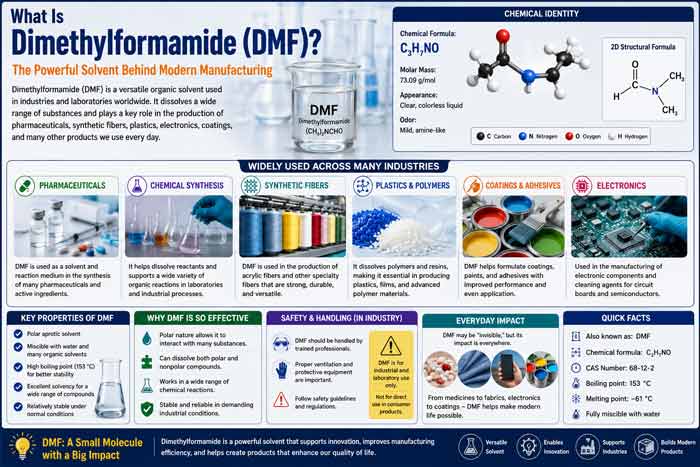
Most people have never heard of dimethylformamide, often abbreviated as DMF. Yet this little-known chemical helps make many of the products we use every day.
From medicines and synthetic fabrics to electronics and industrial coatings, DMF quietly supports countless manufacturing processes around the world.
What makes DMF so valuable is its ability to dissolve substances that many other liquids cannot.
Chemists and manufacturers rely on it because it can help ingredients mix, react, and transform into useful products.
In many ways, DMF acts like a behind-the-scenes problem solver in modern industry.
Although it rarely appears on consumer product labels, its influence can be found in everything from pharmaceuticals to high-performance materials.
Understanding DMF provides a fascinating glimpse into how chemistry helps create the products that shape modern life.
In this article, we’ll explore what dimethylformamide is, why it is such an effective solvent, how it is used in manufacturing, and why it remains an important chemical in laboratories and industry.
What is Dimethylformamide?
Dimethylformamide, commonly called DMF, is an organic solvent widely used in chemical manufacturing and scientific research.
Its chemical formula is: C3H7NO
At room temperature, DMF is typically:
- Clear
- Nearly colorless
- Liquid
- Miscible with water
- Highly effective as a solvent.
Unlike many household liquids, DMF is primarily used in industrial and laboratory settings.
What Does the Name Mean?
The name “dimethylformamide” may sound intimidating, but it simply describes the molecule’s structure.
Chemists often shorten it to DMF because the full name is lengthy and commonly used in technical fields.
Understanding the Molecular Structure of DMF and Its Chemistry
The remarkable properties and chemistry of DMF come from its molecular structure.
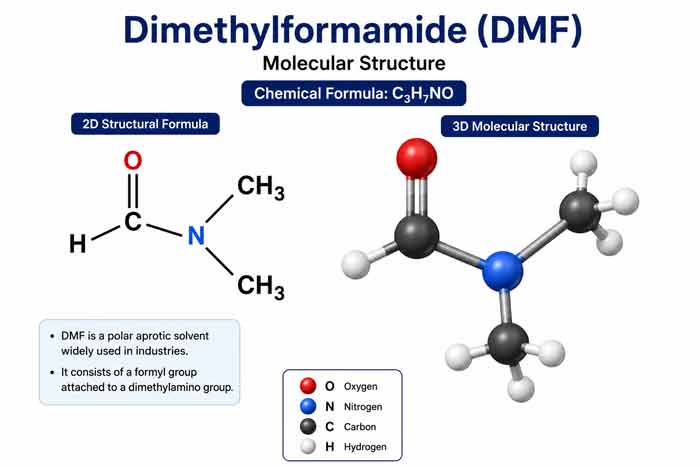
As shown above, the molecular structure of DMF consists of three parts, with each part contributing to its unique behavior.
The different parts are:
- The Carbonyl Group
The oxygen atom double-bonded to carbon forms a carbonyl group. This portion of the molecule contributes to DMF’s polarity.
- The Nitrogen Atom
The nitrogen atom helps give DMF its ability to interact with many different compounds.
- The Two Methyl Groups
The two CH3 groups influence how the molecule interacts with organic substances. Together, these structural features make DMF exceptionally versatile.
Why DMF is Such a Powerful Solvent
To understand DMF’s importance, it helps to understand what a solvent does.
What is a Solvent?
A solvent is a substance that dissolves other materials.
Water is the most familiar example.
It dissolves:
- Salt
- Sugar
- Many everyday substances.
However, water cannot dissolve everything.
Many industrial chemicals, polymers, and organic compounds cannot be dissolved by water, they require different solvents.
This is where DMF excels.
Why DMF Dissolves So Many Materials
DMF contains both polar and organic-friendly characteristics.
As a result, it can dissolve:
- Many organic compounds
- Certain plastics
- Resins
- Polymers
- Chemical intermediates.
This flexibility makes DMF one of the most useful solvents available to chemists.
A Helpful Analogy
Imagine trying to bring together two groups of people who speak different languages.
A translator helps them communicate.
DMF often plays a similar role in chemistry.
It helps substances that would otherwise struggle to mix interact more effectively.
Properties of Dimethylformamide
Dimethylformamide have certain physical and chemical properties that allow chemists and manufacturers to work with them easily. These include:
Physical Properties of Dimethylformamide
Several physical properties contribute to DMF’s popularity, including:
- Appearance: DMF is typically a clear, colorless liquid.
- Solubility: DMF mixes readily with water and many organic liquids. This broad compatibility is one reason it is so widely used.
- Boiling Point: DMF has a relatively high boiling point compared with many common solvents. This allows it to remain liquid during processes that require elevated temperatures.
- Stability: Under normal conditions, DMF is generally stable and can be stored for extended periods when properly handled.
- Odor: DMF has a mild chemical odor that is often less noticeable than some industrial solvents.
Chemical Properties of Dimethylformamide (DMF)
Dimethylformamide (DMF) is valued in chemistry because of its unique chemical behavior and excellent solvent properties.
Here are its most important chemical properties in simple terms:
- Polar Nature
DMF is a highly polar solvent, meaning it has regions of positive and negative charge within the molecule.
This property allows it to dissolve many:
- Organic compounds
- Salts
- Polymers
- Chemical intermediates.
- Excellent Solvent Power
DMF can dissolve substances that many common solvents cannot.
It is particularly effective for:
- Resins
- Plastics
- Synthetic fibers
- Pharmaceutical ingredients.
This is one reason it is widely used in chemical manufacturing.
- Miscibility with Water
Unlike many organic solvents, DMF mixes completely with water.
It is also miscible with many organic solvents, including:
- Acetone
- Ethanol
- Chloroform
- Benzene.
- Relatively Stable Compound
Under normal conditions, DMF is chemically stable and does not react readily with many substances.
This stability makes it useful in chemical reactions that require controlled conditions.
- Participates in Organic Reactions
DMF is not always just a solvent. In some reactions, it can participate directly and influence how reactions proceed.
Because of this, it is widely used in:
- Pharmaceutical synthesis
- Organic chemistry
- Industrial chemical production.
- Hydrolysis under Strong Conditions
When exposed to strong acids, strong bases, or prolonged heating with water, DMF can break down (hydrolyze).
The decomposition products may include:
- Formic acid
- Dimethylamine
- Acts as a Polar Aprotic Solvent
Chemists classify DMF as a polar aprotic solvent.
This means:
- It is highly polar.
- It does not readily donate hydrogen ions (H⁺).
As a result, DMF is useful in many important organic reactions because it helps reactants interact efficiently.
- Compatibility with Many Reagents
DMF can be used alongside many:
- Acids
- Bases
- Catalysts
- Organic reactants.
This versatility makes it one of the most commonly used solvents in research laboratories.
- Combustibility
Although not highly flammable compared with some solvents, DMF is combustible and can burn under appropriate conditions.
- Formation of Coordination Complexes
Because the oxygen and nitrogen atoms contain lone pairs of electrons, DMF can interact with certain metal ions and form coordination complexes.
This property is useful in:
- Materials science
- Catalysis
- Coordination chemistry.
Common Uses of Dimethylformamide
DMF’s ability to dissolve a wide variety of materials makes it useful across many industries. It is used in the following ways:
- Pharmaceutical Manufacturing
Many medicines require multiple chemical reactions during production. DMF often serves as a solvent that helps these reactions occur efficiently.
Because of this, it plays an important role in pharmaceutical manufacturing.
- Chemical Synthesis
Chemists frequently use DMF when creating new compounds. Its solvent properties help reactants mix and interact more effectively.
- Synthetic Fibers
Some synthetic fibers used in clothing and industrial materials are produced using processes that involve DMF.
Examples include certain specialty textiles and performance fabrics.
- Plastics and Polymers
Many plastics and polymer-based materials rely on solvents during production. DMF is often selected because it can dissolve materials that other solvents cannot.
- Adhesives and Coatings
DMF may be used during the manufacture of:
- Industrial coatings
- Specialty paints
- Adhesives
- Protective finishes.
Its solvent properties help ensure smooth and consistent formulations.
DMF in Everyday Life
Most consumers never purchase DMF directly. However, many products they use owe part of their existence to this solvent.
Examples include:
- Pharmaceuticals
- Technical fabrics
- Electronic components
- Industrial coatings
- Specialty plastics.
This makes DMF another example of chemistry working quietly behind the scenes.
Why Industry Depends on DMF
Many manufacturing processes require a solvent that can handle complex materials.
DMF is often chosen because it offers:
- Excellent dissolving power
- Compatibility with many substances
- Stability during reactions
- Versatility across industries
These qualities help improve efficiency and product quality.
Is Dimethylformamide Dangerous?
Like many industrial chemicals, DMF requires proper handling and safety precautions. The fact that a chemical is useful does not mean it should be used carelessly.
Industrial facilities follow strict safety procedures when working with DMF.
Why Professional Handling Matters
Because DMF is designed for industrial and laboratory applications, it is typically managed by trained personnel using appropriate equipment and safety measures.
Its widespread use demonstrates that useful chemistry and safety must go hand in hand.
Common Myths About DMF
Here are common myths about DMF and their truths:
Myth #1: All Solvents Work the Same Way
False.
Different solvents dissolve different materials. DMF is valued because it can dissolve substances that many other solvents cannot.
Myth #2: If You Don’t See a Chemical, It Isn’t Important
False.
Many important chemicals work behind the scenes during manufacturing. DMF is a perfect example.
Myth #3: DMF Is Used Only in Laboratories
False.
While laboratories use DMF extensively, it is also widely used in industrial manufacturing.
Myth #4: Industrial Chemicals Have No Connection to Everyday Life
False.
Many products people use every day depend on industrial chemicals somewhere in their production process.
Surprising Facts about Dimethylformamide
The following are interesting facts about DMF to boost your knowledge-base:
- DMF can dissolve many substances that water cannot.
- It is widely used in pharmaceutical manufacturing.
- It helps produce synthetic fibers and specialty materials.
- It is valuable in both laboratories and industrial facilities.
- Many products rely on DMF at some stage of their production.
- Chemists consider DMF one of the most versatile industrial solvents.
Why DMF Matters
Modern manufacturing depends on chemicals that help ingredients mix, react, and transform efficiently.
DMF is one of those chemicals.
Its ability to serve as a powerful solvent helps support:
- Pharmaceutical production
- Materials science
- Chemical manufacturing
- Product innovation
Without solvents like DMF, many manufacturing processes would become significantly more difficult.
Frequently Asked Questions (FAQs) About Dimethylformamide (DMF)
Here are commonly asked questions about Dimethylformamide and their questions:
- What is Dimethylformamide (DMF)?
Dimethylformamide, commonly known as DMF, is an organic solvent widely used in chemical manufacturing, pharmaceutical production, laboratories, and materials science.
Its chemical formula is: C3H7NO
- Why is DMF called a powerful solvent?
DMF is considered a powerful solvent because it can dissolve many substances that water and some common solvents cannot, including certain polymers, resins, and chemical intermediates.
- What does DMF look like?
DMF is typically a clear, nearly colorless liquid with a mild chemical odor. It remains liquid over a wide range of temperatures, making it useful in industrial processes.
- What industries use DMF?
DMF is used in:
- Pharmaceutical manufacturing
- Chemical synthesis
- Synthetic fiber production
- Plastics manufacturing
- Electronics production
- Adhesives and coatings.
- Why is DMF important in pharmaceutical manufacturing?
DMF helps dissolve ingredients and facilitates chemical reactions needed to create many pharmaceutical compounds. This makes it valuable in drug development and production.
- Does DMF occur naturally?
No. DMF is a synthetic chemical produced through industrial manufacturing processes. It is designed specifically for use in laboratories and industry.
- What makes DMF different from water as a solvent?
While water dissolves many everyday substances such as salt and sugar, DMF can dissolve a broader range of organic compounds, polymers, and chemical intermediates that water cannot.
- Is DMF used only in laboratories?
No. Although laboratories use DMF extensively, much larger quantities are used in industrial manufacturing, including the production of medicines, synthetic fibers, electronics, and specialty materials.
- Is DMF the same as other solvents like acetone or ethanol?
No. While all three are solvents, they have different chemical properties and applications. DMF is often chosen when stronger dissolving power or specific reaction conditions are required.
- Why is DMF important to modern manufacturing?
DMF helps manufacturers produce a wide variety of products by dissolving materials, improving chemical reactions, and supporting efficient production processes. Many pharmaceuticals, advanced materials, and industrial products depend on DMF at some stage of their manufacture.
Conclusion
Dimethylformamide may not be a household name, but it is one of the unsung heroes of modern chemistry.
Its exceptional ability to dissolve a wide range of substances has made it indispensable in laboratories, pharmaceutical manufacturing, synthetic fiber production, plastics, coatings, and many other industries.
Although most people never encounter DMF directly, its influence can be found in countless products and technologies.
It is a reminder that modern life depends not only on the products we see, but also on the specialized chemicals that help create them.
The next time you take a medicine, wear a synthetic fabric, or use a product made from advanced materials, there is a good chance that chemistry — and perhaps even DMF — played a role in bringing it to life.