
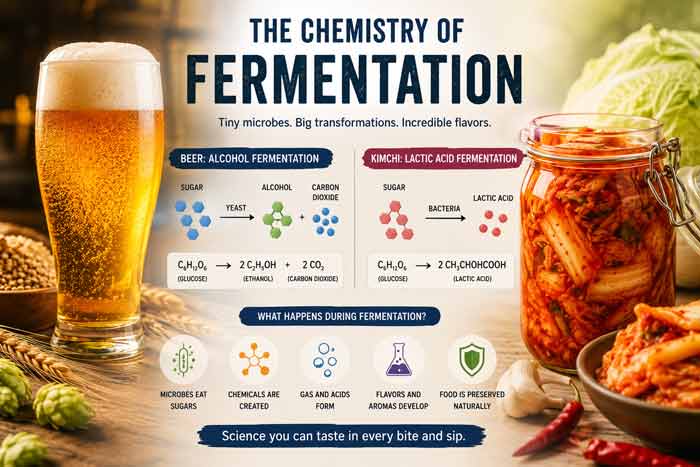
The chemistry of fermentation is one of the most fascinating processes in food science because it explains how tiny microorganisms can completely transform the nature, flavor, texture, and preservation of food.
From ancient civilizations to modern kitchens, fermentation has been used to create some of the world’s most loved foods and drinks.
Fermentation: The Ancient Science Living in Your Food
Imagine biting into sour kimchi, sipping cold beer, eating yogurt, or smelling freshly baked bread.
These foods may seem completely different, but they all share one fascinating thing in common:
They exist because of fermentation.
For thousands of years, humans have used fermentation long before they understood the science behind it.
Ancient people did not know about bacteria, yeast, enzymes, or chemistry.
They only knew that certain foods changed over time — milk became yogurt, grape juice became wine, and cabbage transformed into tangy kimchi.
Today, science explains what earlier civilizations discovered by accident: fermentation is one of the most powerful chemical transformations in food.
At its core, fermentation is controlled chemistry performed by tiny living organisms called microbes.
These microorganisms break down sugars and create entirely new substances, such as acids, alcohol, gases, and flavor compounds.
In the process, they completely transform the taste, texture, smell, and shelf life of food.
What makes fermentation especially fascinating is that it sits at the intersection of chemistry, biology, cooking, and culture.
It is science you can taste.
In this article, we will explore:
- what fermentation really is,
- the chemistry happening inside fermented foods,
- how beer, kimchi, yogurt, and bread are made,
- why fermentation creates powerful flavors,
- and how invisible microbes changed human civilization forever.
So, let’s go:
What Is Fermentation?
Let us start with the basics.
Fermentation is a natural chemical process where microorganisms break down sugars into simpler substances.
These microorganisms are usually:
- yeast,
- bacteria,
- or sometimes molds.
As these microbes consume sugars in food for energy, they produce new compounds like:
- alcohol,
- lactic acid,
- carbon dioxide,
- and flavor molecules.
These new compounds completely change the food.
A Simple Way to Think About Fermentation
Imagine microbes as tiny chemical factories.
They eat sugars and release new chemicals as waste products.
For example:
- yeast turns sugar into alcohol and carbon dioxide,
- while lactic acid bacteria turn sugar into acids that make foods sour.
The amazing part is that humans learned how to guide and control these microscopic workers.
The Main Players: Tiny Microbes with Huge Jobs
As earlier said, fermentation is carried out by microorganisms called microbe and they include yeast, bacterial, and mold.
Now, let’s look at how they work in fermenting food substances:
The Role of Yeast in Fermentation
Yeast are single-celled fungi.
They are famous for making:
- beer,
- wine,
- bread,
- and some traditional drinks.
Yeast feed on sugar and release:
- alcohol,
- and carbon dioxide gas.
The carbon dioxide gas is what makes bread rise and beer bubble.
The Role of Bacteria in Fermentation
When we hear of bacteria, we think of harmful things.
However, not all bacteria are harmful.
Some are incredibly useful.
For example, lactic acid bacteria are responsible for:
- kimchi,
- yogurt,
- pickles,
- sauerkraut,
- and many cheeses.
These bacteria create lactic acid, which gives fermented foods their tangy taste.
The Role of Mold in Fermentation
Some fermentation also involve mold.
For example:
- blue cheese,
- soy sauce,
- miso,
- and tempeh
- depend on special molds to break down proteins and starches.
Although mold sounds scary, certain types are carefully controlled and completely safe.
The Difference between Fermentation and Spoilage
At first glance, fermentation and rotting may seem similar.
Both involve microbes changing food.
So, what is the difference?
The answer is control.
In fermentation:
- humans encourage beneficial microbes,
- create safe conditions,
- and stop dangerous organisms from growing.
On the other hand, spoilage happens when harmful or unwanted microbes take over instead.
Good fermentation creates:
- pleasant flavors,
- preservation,
- and safe food,
while spoilage creates:
- foul smells,
- toxins,
- and unsafe food.
The Basic Chemistry behind Fermentation
Now, let us look at the science behind fermentation itself.
Sugars: The Fuel of Fermentation
Fermentation begins with sugar.
Microbes need energy to survive, and sugar is their favorite fuel.
Common sugars involved in fermentation include:
- glucose,
- fructose,
- lactose,
- and sucrose.
When microbes break these sugars apart, chemical reactions release energy.
At the same time, new substances are formed.
Types of Fermentation
There are different types of fermentation, depending on what is produced.
They include:
Alcohol Fermentation: The Science behind Beer and Wine
One of the most famous forms of fermentation is alcohol fermentation, which can also be called ethanol fermentation because the alcohol produced is a type called ethanol.
This process is mainly carried out by yeast.
How Yeast Makes Alcohol
Yeast consumes glucose (a simple sugar) and converts it into:
- ethanol (alcohol),
- and carbon dioxide gas.
The chemical reaction looks like this:
C6H12O6 → 2C2H5OH + 2CO2
This may look complicated, but it simply means:
Sugar → Alcohol + Gas
The gas creates bubbles.
The alcohol stays in the liquid.
That is the chemistry behind beer, wine, and many alcoholic drinks.
Fermentation and Beer Making
Beer making is an example of alcohol fermentation and it begins mostly with:
- water,
- grains,
- hops,
- and yeast.
The grains contain starch, which is converted into sugar.
Then yeast takes over.
During fermentation:
- sugar decreases,
- alcohol increases,
- carbon dioxide forms,
- and hundreds of flavor chemicals appear.
Some of these flavor compounds create:
- fruity notes,
- spicy aromas,
- caramel flavors,
- or earthy tastes.
Tiny chemical differences create huge flavor differences between beer styles.
Lactic Acid Fermentation: The Science of Kimchi and Yogurt
Another type of fermentation is lactic acid fermentation, which does not produces alcohol.
It produces acid instead, which is known as lactic acid.
How Lactic Acid Fermentation Works
Certain bacteria convert sugars into lactic acid.
The simplified reaction is:
C6H12O6 → 2CH3CHOHCOOH
In simple terms:
Sugar → Lactic Acid
This acid:
- creates sour flavor,
- preserves food,
- and prevents harmful microbes from growing.
Yogurt and Fermented Dairy
An example of lactic acid fermentation is yogurt making.
Milk contains a sugar called lactose.
Certain bacteria break lactose down into lactic acid.
As acid levels increase:
- milk proteins change structure,
- the liquid thickens,
- and yogurt forms.
That tangy taste comes directly from acid production.
Fermentation and Kimchi Making
Kimchi is one of the world’s most famous fermented foods.
It is also made through lactic acid fermentation from:
- cabbage, garlic,
- ginger,
- chili,
- and salt.
At first, salt pulls water from the cabbage.
This creates conditions where beneficial bacteria can thrive.
Over time:
- bacteria consume sugars,
- acids build up,
- flavors deepen,
- and aroma compounds develop.
Fresh cabbage slowly transforms into something completely new.
Kimchi’s strong flavor comes from dozens of chemical compounds created during fermentation, including lactic acid, acetic acid, carbon dioxide, and small amounts of alcohol.
Umami and Fermentation
Many fermented foods are rich in umami — the savory taste linked to foods like:
- cheese,
- soy sauce,
- kimchi,
- and miso.
Fermentation breaks proteins into amino acids such as glutamate, which boosts savory flavor.
This is why fermented foods often taste deep and satisfying.
Why Fermented Drinks Bubble
The bubbles you see in fermented drinks come from carbon dioxide gas that is produced during fermentation.
In sealed containers, the gas becomes trapped under pressure.
When you open the bottle:
- pressure suddenly drops,
- gas escapes,
- and bubbles appear.
That satisfying fizz is chemistry in action.
Why Fermented Foods Taste So Complex
Fermented foods are rarely simple-tasting.
They are often:
- tangy,
- savory,
- earthy,
- fruity,
- funky,
- or deeply rich.
Why?
Because fermentation creates hundreds of flavor molecules.
How this happens:
During fermentation, microbes produce:
- esters,
- organic acids,
- amino acids,
- alcohols,
- and aromatic compounds.
These molecules interact with your senses to create complex flavors.
For example:
- esters often smell fruity,
- acids taste sour,
- amino acids strengthen umami flavor.
Factors that can Affect Fermentation
There are things that can affect fermentation taking place other than the microbes.
Their presence or absence can affect the rate of fermentation or how much of fermentation can take place.
They include:
- Salt
Salt is extremely important in many fermentations.
It helps by:
- controlling harmful microbes,
- drawing moisture from foods,
- improving texture,
- and supporting beneficial bacteria.
Without proper salt levels, fermentation can fail.
- Temperature
Fermentation is sensitive to temperature changers.
Small environmental changes can affect the final food made dramatically.
Warm temperatures speed up fermentation.
Cooler temperatures slow it down.
But faster is not always better.
Slow fermentation often creates deeper and more complex flavors.
This is why artisan bread and traditional fermented foods are often fermented slowly.
- Time
Fermentation takes time to complete and this is why:
Flavor development is gradual.
Microbes need time to:
- consume sugars,
- produce acids,
- create aroma molecules,
- and transform textures.
Good fermentation cannot be rushed too much.
Other Benefits of Fermentation
Apart from fermentation producing some of the world’s best loved food products like beer, wine, Kimchi, Yoghurts, and bread, it is also useful in a number of other ways:
Fermentation and Food Preservation
Long before refrigerators existed, fermentation helped humans store food safely.
It worked because fermentation creates hostile environments for harmful microbes.
How Fermentation Prevents Spoilage
Fermentation can preserve food by:
- increasing acidity,
- producing alcohol,
- reducing oxygen,
- and allowing beneficial microbes to dominate.
Many dangerous bacteria cannot survive under these conditions.
Health Benefits
Fermented foods are often linked to gut health because they contain probiotics.
What Are Probiotics?
Probiotics are beneficial microorganisms that may support digestive health.
Some fermented foods naturally contain probiotics.
However, not all fermented foods still contain live bacteria after processing.
Fermentation can improve digestion by partially breaking down difficult compounds in food.
For example:
- yogurt bacteria reduce lactose levels, making yogurt easier for some people to digest than milk.
Fermentation around the World
Almost every culture developed fermented foods.
For example:
Asia:
- Kimchi
- Soy sauce
- Miso
- Natto
Europe:
- Beer
- Cheese
- Sauerkraut
- Sourdough bread
Africa:
- Garri
- Ogi
- Fermented cassava foods
Middle East and Americas:
- Kefir
- Kombucha
- Fermented cacao
- Traditional corn fermentations
Fermentation is truly global.
When Fermentation Goes Wrong
Fermentation is powerful, but it must be controlled carefully, else it may result in health problem.
Unsafe Fermentation
Poor hygiene or incorrect conditions can allow harmful microbes to grow.
Problems that may arise in such circumstance include:
- contamination,
- mold growth,
- bad odors,
- or dangerous toxins.
Why Cleanliness Matters During Fermentation
Clean equipment helps beneficial microbes to dominate.
Professional fermentation often involves strict sanitation because microbes are everywhere.
Fun Fermentation Experiments to Try at Home
Here are experiments you can try out at home to show the process of fermentation is going on, and they are fun too.
Experiment 1: Yeast Balloon Experiment
Mix:
- warm water,
- sugar,
- and yeast in a bottle.
Place a balloon over the top.
As yeast ferments sugar, carbon dioxide gas inflates the balloon.
You can literally watch fermentation happen.
Experiment 2: Mini Sauerkraut Jar
Mix cabbage with salt and leave it sealed for several days.
Observe:
- bubbling,
- sour smells,
- texture changes,
- and increasing acidity.
Common Myths about Fermentation
“Fermented Foods Are Rotten”
No. Proper fermentation is controlled and safe.
“All Bacteria Are Harmful”
Many bacteria are essential for food production and human health.
“Only Alcoholic Drinks Are Fermented”
Not true.
Bread, yogurt, kimchi, cheese, pickles, soy sauce, and chocolate all involve fermentation.
Frequently Asked Questions (FAQs) about Fermentation
Here are commonly asked questions about fermentation and their answers:
- What is fermentation?
Fermentation is a natural chemical process where microorganisms like yeast or bacteria break down sugars into substances such as alcohol, acids, or gases. This process changes the flavor, texture, and preservation of food.
2. What causes fermentation?
Fermentation is caused by microorganisms feeding on sugars for energy. As they digest the sugars, they produce new compounds like lactic acid, ethanol (alcohol), and carbon dioxide.
3. Is fermentation the same as rotting?
No. Fermentation is controlled microbial activity using beneficial microorganisms, while rotting happens when harmful or unwanted microbes spoil food.
4. Why do fermented foods taste sour?
Many fermented foods become sour because bacteria produce lactic acid during fermentation. This acid gives foods like kimchi, yogurt, and pickles their tangy flavor.
5. How does yeast make alcohol?
Yeast converts sugar into alcohol and carbon dioxide through a chemical reaction called alcohol fermentation.
C6H12O6 → 2C2H5OH + 2CO2
This process is used in beer, wine, and bread making.
6. Why does bread rise during fermentation?
Bread rises because yeast releases carbon dioxide gas while feeding on sugars. The gas becomes trapped in the dough, causing it to expand.
7. Are fermented foods healthy?
Many fermented foods may support digestion and gut health because they can contain beneficial bacteria called probiotics. However, not all fermented foods contain live probiotics after processing.
8. Why is salt important in fermentation?
Salt helps control harmful microbes while allowing beneficial bacteria to grow. It also improves texture and helps preserve fermented foods safely.
9. Can fermentation happen without oxygen?
Yes. Many types of fermentation happen in low-oxygen or oxygen-free environments. This is called anaerobic fermentation.
10. What foods are made through fermentation?
Many everyday foods involve fermentation, including:
- yogurt,
- cheese,
- kimchi,
- bread,
- beer,
- wine,
- pickles,
- soy sauce,
- chocolate,
- and coffee.
Conclusion
Fermentation is one of the most fascinating forms of chemistry in everyday life.
Tiny microbes transform simple ingredients into foods filled with:
• flavor,
• aroma,
• texture,
• preservation,
• and cultural meaning.
From bubbling beer to spicy kimchi, fermentation shows how invisible organisms can reshape food through chemistry.
The next time you eat yogurt, bread, pickles, or chocolate, remember:
You are tasting billions of microscopic chemical reactions that humans have been harnessing for thousands of years.