
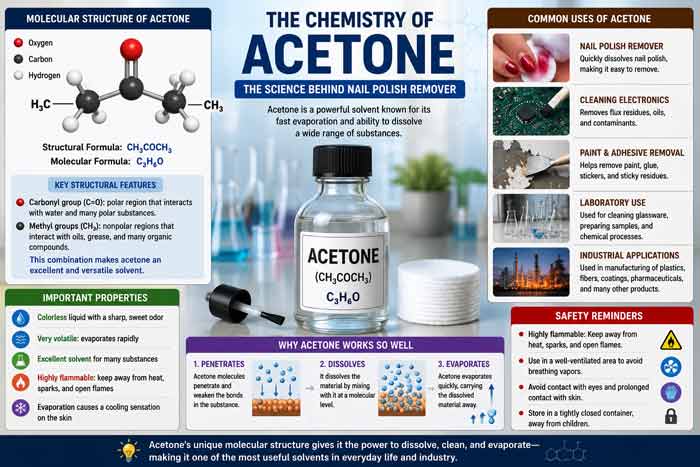
Most people know acetone as the liquid that quickly removes nail polish. Open a bottle of nail polish remover, and you’ll immediately recognize its distinctive smell.
Within seconds of applying it, nail polish begins to dissolve, and the liquid itself seems to disappear almost as quickly as it arrived.
But acetone is much more than a beauty product ingredient.
It is one of the most widely used chemicals in homes, laboratories, hospitals, and industries around the world.
Acetone can dissolve substances that water cannot, clean surfaces, remove adhesives, and evaporate remarkably fast.
It is also a naturally occurring chemical that the human body produces in small amounts.
What makes acetone so useful comes down to chemistry.
Its molecular structure gives it a unique ability to interact with many different substances while evaporating quickly and leaving little residue behind.
These properties have made it one of the most important solvents in modern life.
In this article, we’ll explore what acetone is, why it works so well as a cleaner and solvent, why it evaporates so quickly, and how this everyday chemical is used far beyond nail polish remover.
What is Acetone?
Acetone is a clear, colorless liquid with a strong, distinctive smell.
At first glance, acetone looks a lot like water.
However, there are some important differences.
Unlike water, acetone:
- has a sharp odor,
- evaporates very quickly,
- and can dissolve many substances that water cannot.
These differences are what make acetone such a useful chemical.
Chemists classify acetone as an organic compound, meaning it contains carbon atoms as part of its structure.
Acetone Chemical Formula
Its chemical formula is:
C3H6O
Although that formula may look complicated, acetone is actually a relatively simple molecule.
Acetone Molecular Structure
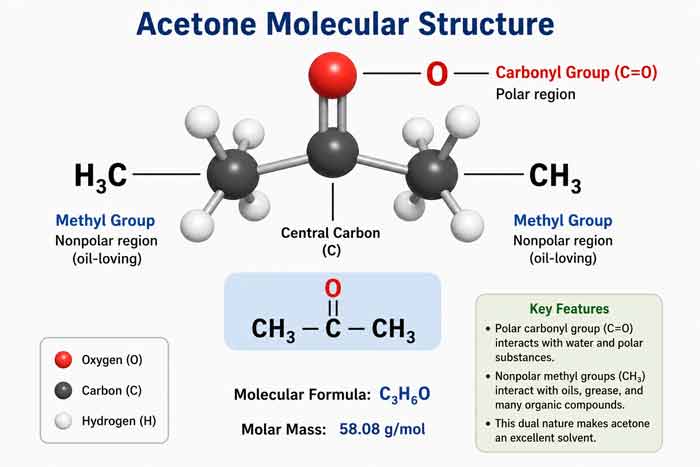
Acetone consists of three carbon atoms, six hydrogen atoms, and one oxygen atom. The most important feature of the molecule is the carbonyl group (C=O) located in the center.
The molecule has two distinct regions:
- The Carbonyl Group (C=O) — The Polar Region
The oxygen atom strongly attracts electrons, creating a slightly negative area around the oxygen and a slightly positive area around the carbon.
This gives acetone a polar character, allowing it to interact with:
- water,
- many organic compounds,
- dyes,
- and various chemicals.
This polarity is one reason acetone is such an effective solvent.
- The Methyl Groups (CH3) — The Oil-Loving Region
The two CH3 groups on either side of the molecule are relatively nonpolar.
These portions interact well with:
- oils,
- grease,
- waxes,
- adhesives,
- and many plastics.
This is why acetone can dissolve substances that water cannot.
Why Acetone Is Such a Powerful Solvent
Acetone is often described as having the “best of both worlds.”
The molecule contains:
| Part of Molecule | Property | What It Interacts With |
| Carbonyl group (C=O) | Polar | Water and polar substances |
| CH3 groups | Nonpolar | Oils, grease, waxes |
Because it can interact with both polar and nonpolar substances, acetone can dissolve a wide variety of materials.
This explains why it is used to:
- remove nail polish,
- clean surfaces,
- dissolve adhesives,
- remove grease,
- and clean laboratory equipment.
Properties Linked to Acetone’s Structure
The following are the properties of acetone that are due to the way its molecules are structured:
- Fast Evaporation
Acetone molecules are held together less strongly than water molecules, allowing them to escape into the air quickly.
- Excellent Solvent
Its combination of polar and nonpolar regions enables it to dissolve many substances.
- Water Miscibility
Unlike oils, acetone mixes completely with water because of its polar carbonyl group.
- Low Residue
Because it evaporates rapidly, acetone usually leaves little behind after cleaning.
- Distinctive Odor
Its small, volatile molecules readily enter the air, producing the characteristic smell associated with nail polish remover.
Why Acetone Evaporates So Quickly
One of the first things people notice about acetone is how quickly it disappears.
Pour a small amount onto a surface, and it may evaporate within seconds.
Why does this happen?
Understanding Evaporation
Evaporation occurs when molecules escape from a liquid and enter the air as a gas.
All liquids evaporate to some degree.
However, some liquids evaporate much faster than others.
Acetone belongs to this fast-evaporating group.
The molecules in acetone are not held together as strongly as water molecules.
This means they require less energy to escape into the air.
As a result:
- acetone evaporates rapidly,
- dries surfaces quickly,
- and leaves very little residue.
This property is one reason acetone is widely used for cleaning and industrial applications.
Why Acetone Feels Cold
Have you ever spilled a little acetone on your skin?
If so, you may have noticed a cooling sensation.
This happens because evaporation requires energy.
As acetone evaporates, it takes heat from your skin.
The loss of heat creates the cool feeling.
This phenomenon is called evaporative cooling.
Why Acetone is Such a Good Solvent
Acetone’s most famous ability is its power to dissolve substances.
This is why it appears in products designed to remove:
- nail polish,
- paint residues,
- adhesives,
- grease,
- oils,
- and various coatings.
What is a Solvent?
A solvent is a substance that dissolves other materials.
Water is the most familiar solvent.
It easily dissolves:
- salt,
- sugar,
- and many household substances.
However, water struggles with oils, waxes, and many synthetic materials.
This is where acetone shines.
Why Water Cannot Remove Nail Polish
Most nail polishes contain compounds that are not easily dissolved by water.
You can soak polished nails in water for a long time with little effect.
Acetone is different.
Its molecular structure allows it to interact with the compounds in nail polish and break them apart.
As the polish dissolves, it can be wiped away.
Dissolving Oils and Grease
Acetone can also dissolve many oily substances.
This makes it useful for:
- removing grease,
- cleaning tools,
- preparing surfaces for painting,
- and removing sticky residues.
Many technicians and hobbyists keep acetone on hand for these reasons.
Common Uses of Acetone
Although nail polish remover is the most familiar use, acetone has many others.
- Nail Polish Remover
This is the application of acetone that most people know best.
Acetone works quickly because it dissolves the ingredients that hold nail polish together.
Within seconds, the polish softens and can be removed.
- Cleaning Electronics
Acetone can dissolve certain residues and contaminants.
However, it must be used carefully around electronics because it can also damage some plastics.
For delicate electronics, other solvents are often preferred.
- Paint and Adhesive Removal
Many paints, glues, and adhesives contain compounds that acetone can dissolve.
This makes it useful for:
- removing labels,
- cleaning tools,
- and eliminating stubborn residues.
- Laboratory Applications
Scientists use acetone for:
- cleaning glassware,
- preparing samples,
- and removing contaminants.
Its rapid evaporation makes it especially useful in laboratory settings.
- Manufacturing and Industry
In manufacturing, acetone plays an important role in the production of:
- plastics,
- synthetic fibers,
- coatings,
- pharmaceuticals,
- and various chemical products.
Many industrial processes rely on acetone as a solvent.
Acetone in the Human Body
One surprising fact about acetone is that your body naturally produces it.
Most people never realize this.
How Does the Body Make Acetone?
When the body breaks down fat for energy, small amounts of acetone can be produced.
This is a completely natural process.
In healthy individuals, the amounts are usually very small.
Fruity Breath and Acetone
Sometimes acetone can contribute to a fruity or sweet smell on a person’s breath.
This occurs because small amounts of acetone can leave the body through exhaled air.
It is one of the ways the body eliminates certain byproducts of metabolism.
Is Acetone Dangerous?
Like many useful chemicals, acetone should be handled responsibly.
Used properly, it is generally safe for its intended purposes.
However, it does have some risks.
It is Flammable
One of the most important things to know about acetone is that it can catch fire easily.
Its vapors are flammable.
For this reason, acetone should be kept away from:
- open flames,
- sparks,
- and high heat sources.
Ventilation is Important
Because acetone evaporates quickly, it can produce noticeable vapors.
Using it in well-ventilated areas helps prevent excessive vapor buildup.
It Should not be Consumed
Acetone is not intended for drinking.
Like many industrial chemicals, it should only be used for its intended purposes.
Common Myths about Acetone
Here are myths people commonly hold about acetone and the true facts:
“Acetone is Artificial”
Not entirely.
Although acetone is manufactured industrially, the human body also produces small amounts naturally.
“Acetone Only Exists in Nail Polish Remover”
False.
Acetone is widely used in science, manufacturing, cleaning products, and laboratories.
“All Solvents Work the Same Way”
Different solvents dissolve different substances.
Acetone’s effectiveness comes from its specific chemical properties.
“Acetone Dissolves Everything”
No solvent dissolves everything.
Acetone is powerful, but some materials resist it completely.
Fun Acetone Experiments You Can Try at Home
The following are fun experiments you can try at home with acetone:
Experiment 1: Compare Evaporation Rates
Place a drop of water and a drop of acetone on separate surfaces.
Observe which disappears first.
This demonstrates acetone’s rapid evaporation.
Experiment 2: Cooling Effect Demonstration
Place a small amount of acetone on one hand and water on the other.
Notice the difference in cooling sensation.
Always use only a tiny amount and avoid sensitive skin.
Experiment 3: Marker Removal Test
Try removing permanent marker from an appropriate non-porous surface using acetone.
Observe how effectively it dissolves certain inks.
Always test in a small area first.
Surprising Facts about Acetone
Here are amazing facts you may not have known about acetone:
- Your body naturally produces small amounts of acetone.
- Acetone evaporates much faster than water.
- It is one of the most commonly used solvents in the world.
- Acetone can dissolve many substances that water cannot.
- It plays important roles in science, medicine, and manufacturing.
- It leaves very little residue after evaporation.
Conclusion
Acetone may be best known as the active ingredient in many nail polish removers, but its importance extends far beyond the beauty aisle.
Its unique chemistry allows it to:
- dissolve stubborn substances,
- remove oils and residues,
- evaporate rapidly,
- and assist in countless industrial and scientific processes.
From laboratories and factories to homes and salons, acetone is a powerful example of chemistry at work in everyday life.
What seems like a simple liquid is actually a remarkably versatile molecule whose properties make modern cleaning, manufacturing, and countless other activities possible.
The next time you smell nail polish remover or watch acetone quickly evaporate from a surface, you’ll know there’s fascinating chemistry behind every drop.