
Ethanol is one of the most familiar chemicals in the world, yet most people know surprisingly little about it.
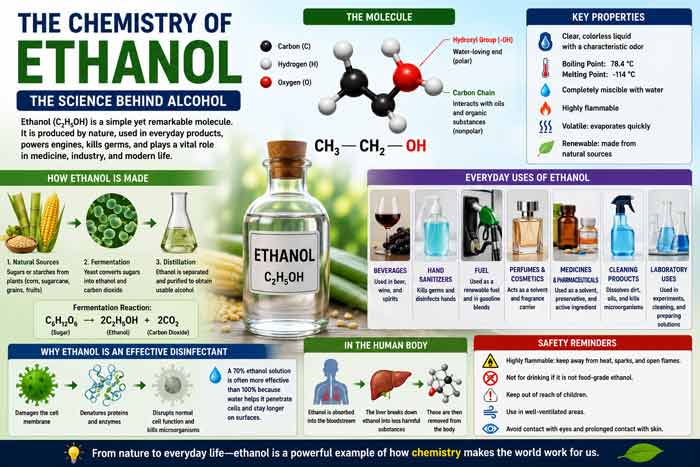
It appears in alcoholic beverages, hand sanitizers, perfumes, medicines, cleaning products, and even fuel.
Whether you’re enjoying a glass of wine, using a disinfectant wipe, or filling a vehicle with ethanol-blended gasoline, you’re interacting with this remarkable molecule.
What makes ethanol so fascinating is its versatility.
The same substance that can be produced by fermenting fruit or grains can also kill germs, dissolve chemicals, power engines, and evaporate quickly from surfaces.
Few molecules have found their way into so many aspects of daily life.
The story of ethanol is also the story of chemistry in action.
Its unique molecular structure gives it properties that make it useful in medicine, industry, food production, and science.
Understanding how ethanol works helps explain everything from why hand sanitizer dries so quickly to why alcohol affects the human body.
In this article, we’ll explore the chemistry behind ethanol, how it is made, why it behaves the way it does, and why it remains one of the most important chemicals in the modern world.
What is Ethanol?
Ethanol is a clear, colorless liquid that belongs to a family of chemicals known as alcohols.
When people use the word “alcohol” in everyday conversation, they are usually referring specifically to ethanol.
Chemically, ethanol is a relatively simple molecule.
Molecular Formula of Ethanol
The chemical or molecular formula of ethanol is:
C2H6O or C2H5OH
This means each molecule contains:
- 2 carbon atoms
- 6 hydrogen atoms
- 1 oxygen atom.
Although the formula is simple, it gives ethanol some very useful properties.
Molecular Structure of Ethanol
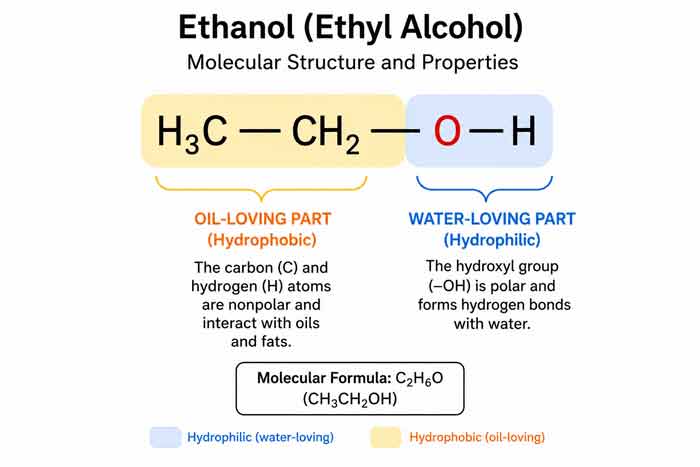
The molecular structure of ethanol shows that ethanol contains two distinct parts:
- The Water-Loving End
One end of the molecule contains a hydroxyl group:
−OH
This portion interacts well with water.
Scientists sometimes describe it as hydrophilic, which simply means “water-loving.”
- The Oil-Loving End
The carbon-and-hydrogen portion of the molecule behaves differently.
It interacts more easily with:
- oils,
- fats,
- and many organic substances.
This gives ethanol a partially “oil-loving” character.
Why This Structure Matters
Because ethanol contains both a water-loving and an oil-loving region, it can interact with a wide range of substances.
This is one reason it works well as:
- a disinfectant,
- a solvent,
- a fuel,
- and an ingredient in many consumer products.
Its molecular structure is the secret behind its versatility.
Properties of Ethanol
Ethanol exhibits certain unique physical and chemical properties due to its peculiar molecular structure that consists of the carbon backbone and the hydroxyl functional group.
They include:
Physical Properties of Ethanol
Ethanol displays the following physical properties:
- Appearance: Clear, colorless liquid
- Odor: Mild, characteristic alcoholic smell
- Chemical Formula: C2H6OC_2H_6OC2H6O
- Boiling Point: Approximately 78.4°C (173.1°F)
- Melting Point: Approximately -114°C (-173°F)
- Density: About 0.79 g/cm³ (less dense than water)
- Solubility: Completely miscible with water
- Volatility: Evaporates quickly
- Flammability: Highly flammable liquid
- Taste: Slightly sweet and burning.
Chemical Properties of Ethanol
The following are major chemical properties that ethanol shows:
- Combustion: Ethanol burns in oxygen to produce carbon dioxide, water, and energy. C2H5OH + 3O2 → 2CO2 + 3H2O
- Oxidation: Can be oxidized to form acetaldehyde and eventually acetic acid (vinegar).
- Reaction with Sodium: Reacts with sodium metal to produce hydrogen gas and sodium ethoxide.
- Ester Formation: Reacts with acids to form esters, which are often responsible for fruity aromas.
- Solvent Properties: Dissolves many organic compounds, oils, fragrances, medicines, and dyes.
- Disinfectant Action: Denatures proteins and damages cell membranes, helping kill many microorganisms.
How Ethanol is Made
One of the most interesting things about ethanol is that it can be produced naturally.
Humans have been making ethanol for thousands of years — long before they understood the science involved.
The key process is called fermentation.
What is Fermentation?
Fermentation is a natural process carried out by microscopic organisms called yeast.
Yeast feed on sugars and convert them into:
- ethanol,
- and carbon dioxide gas.
The basic reaction looks like this:
C6H12O6 → 2C2H5OH + 2CO2
In simple terms:
Sugar → Ethanol + Carbon Dioxide
Where Does the Sugar Come From?
The sugars used for fermentation can come from many sources, including:
Grains
- corn
- barley
- wheat
Fruits
- grapes
- apples
- berries
Sugar-Rich Crops
- sugarcane
- sugar beets
As long as yeast has access to sugar, fermentation can occur.
Why Ethanol Evaporates So Quickly
Have you ever used hand sanitizer and noticed that it dries within seconds?
Or smelled alcohol from a freshly opened bottle?
These experiences happen because ethanol evaporates very easily.
What Is Evaporation?
Evaporation occurs when molecules escape from a liquid and enter the air as a gas.
All liquids evaporate.
However, some evaporate much faster than others.
Ethanol is one of them.
Why Ethanol Molecules Escape Easily
Compared with water, ethanol molecules are not held together as strongly.
As a result:
- less energy is needed for them to escape,
- evaporation occurs more rapidly,
- and surfaces dry faster.
This property makes ethanol useful for cleaning and disinfecting.
Why Ethanol Feels Cool
If you’ve ever spilled alcohol-based sanitizer on your skin, you’ve probably felt a cooling sensation.
This happens because evaporation requires energy.
As ethanol evaporates:
- it absorbs heat from your skin,
- heat leaves the surface,
- and your skin feels cooler.
This process is called evaporative cooling.
Everyday Uses of Ethanol
Many people use ethanol every day without realizing it. Its versatility has made it a common ingredient in countless products.
Here are some of the major uses of ethanol:
- Alcoholic Beverages
This is the most familiar use of ethanol.
Beer, wine, cider, and spirits all contain ethanol produced through fermentation.
Different production methods create different flavors, aromas, and alcohol concentrations.
- Hand Sanitizers
Many sanitizers rely on ethanol’s disinfecting properties to reduce microorganisms on the skin.
Hand sanitizers became especially familiar during periods of heightened public health awareness.
Ethanol is commonly used in hand sanitizers because it:
- works quickly,
- dries rapidly,
- leaves little residue,
- and does not require rinsing.
When soap and water are unavailable, alcohol-based sanitizers provide a convenient alternative.
- Medicines
Ethanol appears in some medicines because it can:
- dissolve ingredients,
- preserve formulations,
- and help deliver active compounds.
- Perfumes and Fragrances
Many perfumes contain ethanol.
It acts as a carrier that helps fragrance molecules spread into the air.
Without evaporation, perfumes would not work nearly as well.
- Cleaning Products
Ethanol appears in:
- glass cleaners,
- disinfectants,
- electronics cleaners,
- and household sprays.
Its ability to dissolve oils and evaporate quickly makes it an excellent cleaning agent.
- Laboratory Applications
Scientists frequently use ethanol in laboratories.
Common applications include:
- cleaning equipment,
- preserving samples,
- preparing solutions,
- and conducting experiments.
- Ethanol as a Fuel
Ethanol is not just useful in medicine and cleaning. It can also power engines.
In fact, ethanol is one of the world’s most important renewable fuels.
What Makes Ethanol a Fuel?
Like gasoline, ethanol contains stored chemical energy.
When burned, ethanol reacts with oxygen and releases energy in the form of heat.
This energy can be used to power engines and machinery.
Ethanol-Blended Gasoline
Many countries mix ethanol with gasoline.
Common blends include:
- E10 (10% ethanol)
- E15 (15% ethanol)
- E85 (85% ethanol).
These blends help reduce reliance on fossil fuels.
Why Ethanol is Considered Renewable Energy
Unlike petroleum, ethanol can be produced from plants.
Common sources include:
- corn,
- sugarcane,
- wheat,
- and other crops rich in sugars or starches.
As new crops are grown, more ethanol can be produced.
This renewable cycle makes ethanol attractive as an alternative energy source.
Ethanol and the Human Body
Because ethanol is found in alcoholic beverages, it has a unique relationship with the human body.
How the Body Processes Ethanol
After ethanol is consumed, it enters the bloodstream and travels throughout the body.
The liver performs most of the work involved in breaking it down.
Through a series of chemical reactions, ethanol is converted into other compounds that can eventually be removed from the body.
Why Ethanol Affects the Brain
Ethanol can influence communication between nerve cells.
This can affect:
• mood,
• coordination,
• judgment,
• reaction time,
• and perception.
The effects depend on many factors, including:
- the amount consumed,
- body size,
- food intake,
- and individual biology.
Common Myths about Ethanol
Because ethanol is so common, several misconceptions surround it.
Now, let’s separate fact from fiction:
Myth #1: All Alcohols Are Safe to Drink
False.
Ethanol is the alcohol found in beverages and so is safe to be consumed.
Other alcohols, such as:
- methanol,
- and isopropanol,
can be dangerous or even fatal if consumed.
Myth #2: Ethanol Only Exists in Alcoholic Drinks
False.
Ethanol is also found in:
- sanitizers,
- medicines,
- fuels,
- perfumes,
- cleaning products,
- and industrial applications.
Myth #3: Ethanol Is Entirely Artificial
False.
Ethanol occurs naturally through fermentation.
Humans have been producing it from fruits and grains for thousands of years.
Surprising Facts about Ethanol
Here are amazing ethanol facts to increase your knowledge-base:
- Ethanol is produced naturally by yeast during fermentation.
- It can be used as both a beverage ingredient and a fuel.
- It is one of the most widely used disinfectants in the world.
- Many perfumes rely on ethanol to carry fragrances.
- Ethanol evaporates much faster than water.
- It is used in medicine, science, manufacturing, and transportation.
- Humans have been producing ethanol for thousands of years.
- It is one of the most versatile chemicals in everyday life.
Frequently Asked Questions (FAQs) About Ethanol
Here are questions that are commonly asked about ethanol:
- What is ethanol?
Ethanol is a type of alcohol commonly found in alcoholic beverages, hand sanitizers, medicines, perfumes, and fuels. It is a clear, colorless liquid with the chemical formula:
C2H6O
- How is ethanol produced?
Ethanol is primarily produced through fermentation, a natural process in which yeast converts sugars from fruits, grains, or sugarcane into alcohol and carbon dioxide.
- Is ethanol the same as alcohol?
In everyday language, “alcohol” usually refers to ethanol. However, in chemistry, alcohol is a broader family of compounds that includes methanol, isopropanol, and other alcohols.
- Why does ethanol evaporate so quickly?
Ethanol molecules are not held together as strongly as water molecules. This allows them to escape into the air more easily, causing ethanol to evaporate rapidly.
- Why is ethanol used in hand sanitizers?
Ethanol can kill many bacteria and viruses by disrupting their protective structures and proteins. It also evaporates quickly, making it convenient for sanitizing hands without needing water.
- Can ethanol be used as a fuel?
Yes. Ethanol is widely used as a renewable fuel and is often blended with gasoline to power vehicles. It can be produced from crops such as corn and sugarcane.
- Is ethanol found only in alcoholic beverages?
No. Ethanol is also found in:
- Hand sanitizers
- Perfumes
- Medicines
- Cleaning products
- Laboratory chemicals
- Biofuels.
- What is the difference between ethanol and methanol?
Ethanol is the alcohol found in beverages and can be consumed in moderation. Methanol is a different type of alcohol that is highly toxic and can cause serious health problems if ingested. Read more about the difference between methanol and ethanol.
- Why does ethanol feel cold on the skin?
When ethanol evaporates, it absorbs heat from the surface it is on. This process, known as evaporative cooling, creates a cooling sensation on the skin.
- Why is ethanol considered an important chemical?
Ethanol is one of the world’s most versatile chemicals. It is used in medicine, sanitation, manufacturing, transportation, scientific research, and food production. Its ability to act as a solvent, disinfectant, fuel, and preservative makes it valuable across many industries.
Conclusion
Ethanol is far more than the alcohol found in beer, wine, and spirits. It is a remarkable molecule that plays important roles in medicine, science, manufacturing, cleaning, transportation, and everyday life.
Its unique molecular structure allows it to interact with water, dissolve many substances, evaporate quickly, and act as an effective disinfectant.
These properties have made ethanol one of the most useful chemicals ever discovered.
From ancient fermentation practices to modern hand sanitizers and renewable fuels, ethanol continues to shape the world around us.
Whether it’s helping preserve medicines, power vehicles, clean surfaces, or create beverages, this simple molecule demonstrates how chemistry influences daily life in countless ways.
The next time you use a sanitizer, smell a perfume, fill up a fuel tank, or learn about fermentation, you’ll know that ethanol is quietly at work behind the scenes — one of the most versatile molecules in the modern world.