
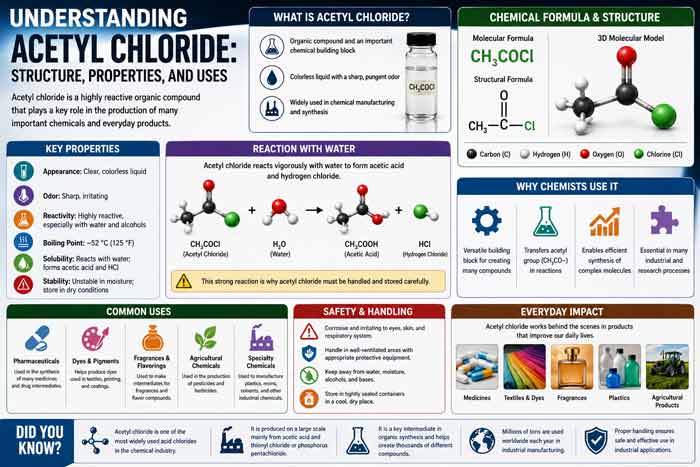
Although most people have never heard of acetyl chloride, this highly useful chemical plays an important role in the production of medicines, dyes, fragrances, plastics, and many other industrial products.
Chemists value it because it can help transform simple molecules into more complex and useful ones.
What makes acetyl chloride especially interesting is its reactivity. Unlike chemicals that remain stable under most conditions, acetyl chloride readily participates in chemical reactions.
This eagerness to react makes it a powerful tool in chemical manufacturing and scientific research.
In this article, we’ll explore what acetyl chloride is, how its structure influences its properties, why chemists use it, and how it contributes to products that affect our daily lives.
What is Acetyl Chloride?
Acetyl chloride is an organic compound that belongs to a family of chemicals known as acid chlorides.
Acetyl Chloride Chemical Formula
The chemical formula of acetyl chloride is:
CH3COCl
At room temperature, acetyl chloride is:
- A clear, colorless liquid
- Highly reactive
- Sharp-smelling
- Widely used in chemical manufacturing.
Although it may look like an ordinary liquid, its chemical behavior is anything but ordinary.
Understanding the Structure of Acetyl Chloride
The behavior of acetyl chloride is closely linked to its molecular structure.
Acetyl Chloride Molecular Structure
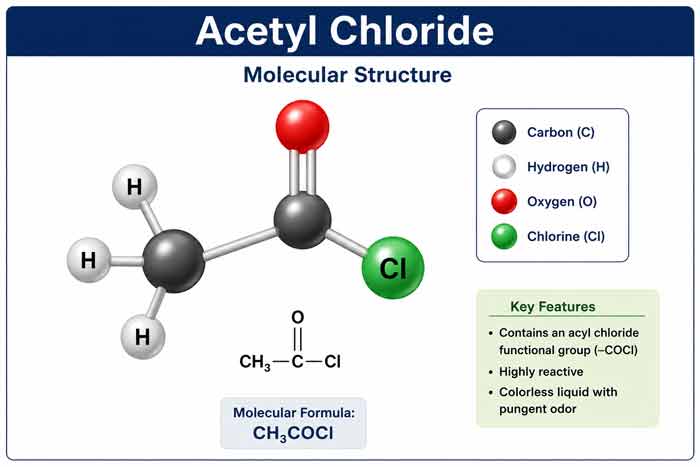
The molecular structure of acetyl chloride contains three important parts:
- The Methyl Group (CH3)
This carbon-and-hydrogen section forms one end of the molecule.
- The Carbonyl Group (C=O)
The carbon atom double-bonded to oxygen is called a carbonyl group. This part strongly influences the molecule’s chemical behavior.
- The Chlorine Atom (Cl)
The chlorine atom attached to the carbonyl carbon is what makes acetyl chloride particularly reactive.
Chemists often use this reactive site to create new compounds.
Properties of Acetyl Chloride
Acetyl chloride displays both physical and chemical properties that make it to behave in certain ways.
Physical Properties of Acetyl Chloride
Although acetyl chloride is mainly valued for its chemical behavior, it also has several notable physical properties, which include:
- Appearance: Clear, colorless liquid.
- Odor: Sharp, pungent, and irritating.
- State: Liquid at room temperature.
- Volatility: Evaporates relatively easily.
- Solubility: Reacts with water rather than simply dissolving in it.
The above characteristics make acetyl chloride easy to transport and use in industrial processes while also requiring careful handling.
Chemical Properties of Acetyl Chloride
The chemical properties of acetyl chloride are what make it so valuable.
Acetyl chloride is highly reactive and therefore readily participates in many chemical reactions.
Chemical Reactions of Acetyl Chloride
Here are major chemical reactions acetyl chloride takes part in:
- Acylation Reactions
Acetyl chloride can transfer its acetyl group to other molecules.
This process is called acylation and is widely used in organic chemistry.
- Reaction With Water
Water and acetyl chloride do not get along very well.
In fact, they react readily.
When acetyl chloride comes into contact with water, a chemical reaction occurs that produces:
- Acetic acid
- Hydrogen chloride
The reaction can be represented as:
CH3COCl + H2O → CH3COOH + HCl
This reaction demonstrates just how reactive acetyl chloride is.
Unlike many liquids that simply mix with water, acetyl chloride undergoes a chemical transformation.
This property is one reason it must be stored and handled carefully in industrial settings.
Formation of New Compounds
Acetyl chloride can help produce new compounds such as:
- Esters
- Amides
- Pharmaceuticals
- Specialty chemicals.
Why Acetyl Chloride is So Reactive
One of acetyl chloride’s defining characteristics is its eagerness to react.
But why?
The answer lies in the chlorine atom.
The bond between the carbonyl carbon and chlorine can be broken relatively easily during chemical reactions.
As a result:
- Other molecules can replace the chlorine atom.
- New chemical compounds can form.
- Complex manufacturing processes become possible.
This reactivity is exactly why acetyl chloride is so useful.
Why Acetyl Chloride is Important
Chemists often think of acetyl chloride as a molecular building block.
Instead of being used directly by consumers, it is frequently used to help manufacture other chemicals.
Many industrial processes rely on acetyl chloride because it can efficiently introduce an acetyl group into other molecules.
This ability makes it valuable in the production of:
- Pharmaceuticals
- Dyes
- Fragrances
- Agricultural chemicals
- Specialty materials.
Common Uses of Acetyl Chloride
Although consumers rarely encounter acetyl chloride directly, many products depend on it somewhere in their manufacturing process. These include:
- Pharmaceutical Manufacturing
One of acetyl chloride’s most important uses is in the production of medicines.
It helps chemists build more complex molecules used in pharmaceutical products.
Many modern drug-development processes involve reactions that use acetyl chloride or related compounds.
- Dyes and Pigments
Colorful dyes used in:
- Textiles
- Printing
- Industrial materials
often require chemical intermediates made using acetyl chloride.
- Fragrances and Flavorings
Many fragrance compounds begin with relatively simple chemical building blocks. Acetyl chloride helps create some of these intermediate compounds.
- Agricultural Chemicals
The manufacture of certain crop-protection products and specialty agricultural chemicals may involve acetyl chloride during production.
- Chemical Manufacturing
Acetyl chloride is frequently used as a starting material for creating other industrial chemicals. Its versatility makes it valuable across multiple industries.
Acetyl Chloride in Everyday Life
Most people will never purchase acetyl chloride.
However, they regularly encounter products that owe part of their existence to it.
Examples include:
- Medicines
- Fabrics
- Dyes
- Specialty plastics
- Fragrances
- Industrial materials.
This makes acetyl chloride an example of a chemical that works behind the scenes. While consumers rarely see it, manufacturers and chemists depend on it.
Is Acetyl Chloride Dangerous?
Like many industrial chemicals, acetyl chloride must be handled responsibly.
Its high reactivity makes it useful, but also means it requires proper safety controls.
Potential concerns include:
- Irritating vapors
- Corrosive behavior
- Reactions with moisture.
For these reasons, industrial facilities use specialized equipment and safety procedures when working with acetyl chloride.
Common Myths about Acetyl Chloride
Here are common myth about Acetyl Chloride and their truth:
Myth #1: Acetyl Chloride Is Found in Household Products
False.
Consumers generally do not encounter acetyl chloride directly. It is primarily an industrial chemical.
Myth #2: More Reactive Means Better
False.
Reactivity is useful only when controlled properly. Too much uncontrolled reactivity can create challenges in manufacturing.
Myth #3: Only Chemists Benefit From Acetyl Chloride
False.
Many products used by ordinary people are made using chemicals that originated from acetyl chloride-based processes.
Myth #4: Industrial Chemicals Have No Everyday Importance
False.
Many medicines, materials, and products depend on industrial chemistry. Acetyl chloride is one example.
Surprising Facts about Acetyl Chloride
The following are amazing facts about acetyl chloride to boost your knowledge-base:
- Acetyl chloride is one of chemistry’s most useful building-block molecules.
- It reacts readily with water.
- It helps manufacture many pharmaceuticals.
- A small amount can help create much larger and more complex molecules.
- It is widely used in organic synthesis.
- Many products people use daily depend indirectly on acetyl chloride chemistry.
Frequently Asked Questions (FAQs) About Acetyl Chloride
Here are questions that are frequently asked about acetyl chloride and their answers:
- What is acetyl chloride?
Acetyl chloride is an organic chemical compound used primarily in industrial chemistry and laboratories as a building block for producing pharmaceuticals, dyes, fragrances, and other specialty chemicals.
Its chemical formula is: CH3COCl
- What does acetyl chloride look like?
Acetyl chloride is a clear, colorless liquid. It has a sharp, pungent odor and is highly reactive, especially when exposed to moisture.
- Why is acetyl chloride important?
Acetyl chloride is important because it helps chemists create more complex molecules. It is widely used in the manufacture of medicines, dyes, agricultural chemicals, and other industrial products.
- What makes acetyl chloride so reactive?
Its reactivity comes largely from the chlorine atom attached to the carbonyl group. This structure makes it easy for acetyl chloride to participate in chemical reactions and form new compounds.
- What happens when acetyl chloride comes into contact with water?
Acetyl chloride reacts readily with water, producing acetic acid and hydrogen chloride gas.
The reaction can be represented as:
CH3COCl + H2O → CH3COOH + HCl
This is why it must be protected from moisture during storage and industrial use.
- Is acetyl chloride found in household products?
Not usually. Most consumers never encounter acetyl chloride directly. Instead, it is used behind the scenes during the manufacture of products that people use every day.
- What industries use acetyl chloride?
Acetyl chloride is commonly used in:
- Pharmaceutical manufacturing
- Dye and pigment production
- Fragrance manufacturing
- Agricultural chemical production
- Specialty chemical industries
- Is acetyl chloride dangerous?
Acetyl chloride can be hazardous because it is highly reactive and can release irritating vapors when exposed to moisture. Industrial facilities use strict safety measures when handling it.
- What is the difference between acetyl chloride and acetic acid?
Although their names sound similar, they are different chemicals. Acetic acid is the main acid found in vinegar, while acetyl chloride is a much more reactive compound used primarily in chemical synthesis and manufacturing.
- Why do chemists prefer acetyl chloride for certain reactions?
Chemists value acetyl chloride because it can efficiently transfer an acetyl group to other molecules. This ability makes it a versatile and powerful tool for creating pharmaceuticals, fragrances, dyes, and many other useful compounds.
Conclusion
Acetyl chloride may not be a household name, but it is an important player in modern chemistry.
Its unique structure, high reactivity, and versatility make it an essential building block for producing medicines, dyes, fragrances, agricultural chemicals, and countless other materials.
By helping chemists construct more complex molecules, acetyl chloride contributes to products that touch everyday life — even if most people never realize it.
It is a reminder that some of the most important chemicals are not the ones we see on store shelves, but the ones quietly working behind the scenes to make modern manufacturing possible.