
Most drivers know that their vehicle contains antifreeze, but few understand what it actually does.
Many assume its only purpose is to prevent engine fluids from freezing during cold weather.
While that is certainly one of its jobs, antifreeze does much more than its name suggests.
In reality, antifreeze is one of the most important liquids inside a vehicle.
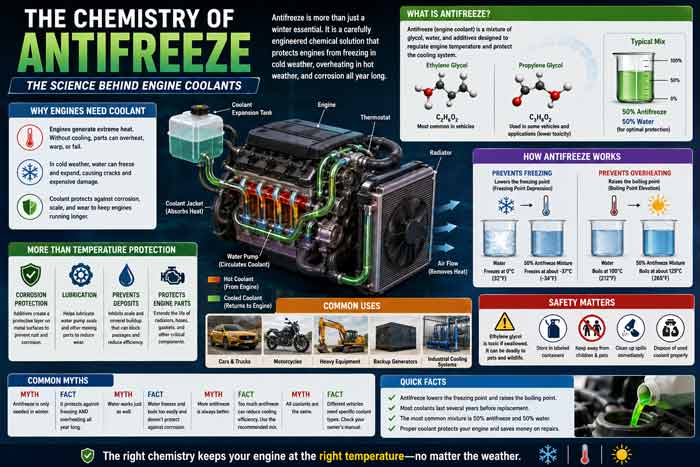
It helps prevent freezing in winter, overheating in summer, corrosion throughout the year, and damage to critical engine components.
Without antifreeze, modern engines would struggle to operate efficiently and could suffer serious damage under both hot and cold conditions.
The secret behind antifreeze lies in chemistry. By mixing specific chemicals with water, scientists have created a coolant that can withstand a wide range of temperatures while protecting engines from wear and corrosion.
This simple-looking liquid is a remarkable example of chemistry solving real-world problems.
In this article, we’ll explore what antifreeze is, how it works, and why it plays such a vital role in keeping engines running smoothly.
What is Antifreeze?
Antifreeze is a chemical liquid that is mixed with water and used in vehicle cooling systems.
Its primary purpose is to regulate engine temperature and protect the cooling system.
Most antifreeze products are based on one of two chemicals:
Ethylene Glycol:
Chemical Formula: C2H6O2
Or
Propylene Glycol:
Chemical Formula: C3H8O2
A similar compound often used in applications where lower toxicity is preferred.
Both chemicals share an important characteristic: they change how water behaves.
Molecular Structures of Ethylene Glycol and Propylene Glycol
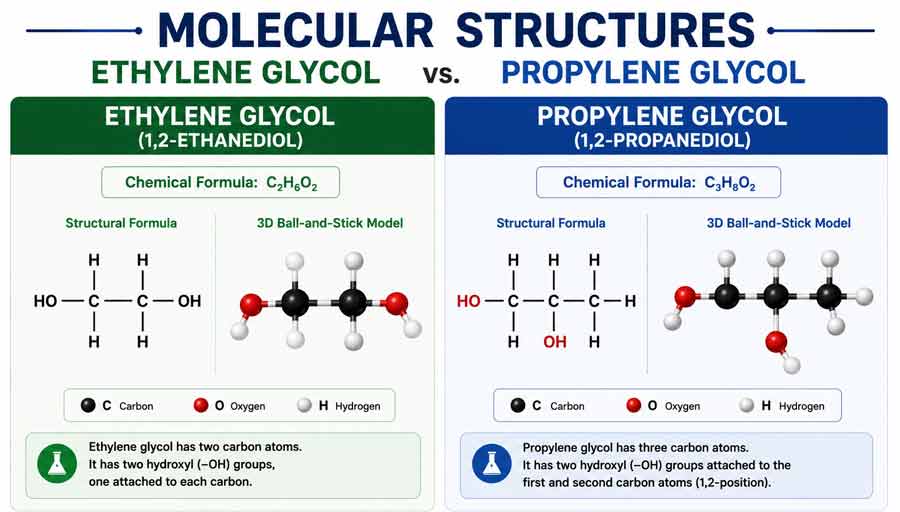
The above image shows the similarity in the molecular structures of both ethylene glycol and propylene glycol.
Both have two hydroxyl groups (-OH) attached to carbon atoms. Having two hydroxyl groups gives them the glycol part of their names.
The similarity in their molecular structures makes them to also have similar chemical properties, which is why they can be used as antifreeze.
Why is Antifreeze Mixed with Water?
Many people are surprised to learn that antifreeze is rarely used by itself.
Instead, it is usually mixed with water.
A common mixture is:
- 50% antifreeze
- 50% water
This combination provides excellent protection against both freezing and overheating.
Water is very good at transferring heat, while antifreeze improves temperature resistance and protects the cooling system.
Together, they form an effective coolant.
Why Engines Need Coolant
An engine generates enormous amounts of heat. Every time fuel burns inside the engine:
- energy is released,
- temperatures rise,
- and heat must be removed.
Without cooling, engine temperatures would quickly become high enough to damage metal components.
The Problem with Heat
Engines operate best within a specific temperature range.
If temperatures rise too much:
- metal parts expand excessively,
- lubricating oils break down,
- components wear more quickly,
- and engine damage can occur.
This is why cooling systems are essential.
The Problem with Cold Weather
Water alone presents another challenge. Pure water freezes at 0oC. When water freezes, it expands.
If water inside an engine freezes:
- hoses may crack,
- radiators can rupture,
- engine components may be damaged.
Antifreeze helps prevent this problem.
How Antifreeze Prevents Freezing
One of antifreeze’s most important functions is lowering the freezing point of water. This effect is known as freezing point depression.
What Happens When Antifreeze is Added?
When antifreeze molecules mix with water molecules, they interfere with the formation of ice crystals.
As a result:
- water remains liquid at lower temperatures,
- freezing becomes more difficult,
- and the cooling system stays protected.
This is why a properly mixed coolant can remain liquid far below the normal freezing point of water.
Why This Matters
In cold climates, temperatures can easily fall below the freezing point of water.
Without antifreeze:
- cooling systems could freeze,
- expensive repairs could result,
- and vehicles might become inoperable.
Antifreeze provides protection throughout the winter months.
How Antifreeze Prevents Overheating
This is the part many people don’t expect. Antifreeze doesn’t just help in winter. It also helps in summer.
Raising the Boiling Point
Water boils at: 100oC. Engines can easily generate temperatures approaching or exceeding this level.
If coolant boils:
- steam forms,
- heat transfer becomes less effective,
- and overheating can occur.
Adding antifreeze raises the boiling point of the mixture. This means the coolant can absorb more heat before boiling.
Better Temperature Protection
Because antifreeze:
- lowers the freezing point,
- and raises the boiling point,
it creates a much wider safe operating range.
This allows engines to function reliably in both winter and summer.
The Chemistry behind Antifreeze
At first glance, antifreeze appears simple. But the science behind it is fascinating.
Changing Water’s Behavior
Water molecules naturally organize themselves into ice crystals when temperatures drop.
Antifreeze molecules get in the way of this process. They make it more difficult for water molecules to arrange themselves into solid ice.
As a result:
- freezing occurs at lower temperatures,
- and ice formation is delayed.
Affecting Boiling
The same dissolved molecules also make it harder for water molecules to escape into the air as vapor.
This raises the boiling point.
In simple terms:
Antifreeze helps water stay liquid across a wider range of temperatures.
More than Temperature Protection
Modern antifreeze does more than regulate temperature. It also protects the cooling system itself in a number of ways, including:
- Corrosion Prevention
Cooling systems contain:
- aluminum,
- steel,
- copper,
- brass,
- and other metals.
Over time, water alone can contribute to corrosion.
Modern antifreeze contains additives that help prevent rust and corrosion.
- Lubricating Components
Antifreeze also helps lubricate certain parts of the cooling system.
This can reduce wear on:
- water pumps,
- seals,
- and related components.
- Preventing Deposits
Minerals and contaminants can form deposits inside cooling systems. Many coolant formulations help reduce these buildup problems.
Common Uses of Antifreeze
Although cars are the most familiar example, antifreeze is used in many other applications.
Here are areas where antifreeze is used:
- Cars and Trucks
The vast majority of antifreeze is used in vehicle cooling systems.
- Motorcycles
Many motorcycles use liquid-cooled engines that depend on antifreeze.
- Heavy Equipment
Construction and agricultural machinery often rely on coolant systems containing antifreeze.
- Backup Generators
Emergency power systems frequently use engine coolants.
- Industrial Cooling Systems
Various industrial processes use antifreeze solutions to manage temperatures.
Is Antifreeze Dangerous?
Like many useful chemicals, antifreeze must be handled responsibly.
Toxicity Concerns
Traditional ethylene glycol antifreeze can be toxic if swallowed.
Because it may have a sweet taste, accidental exposure can be particularly dangerous for:
- children,
- pets,
- and wildlife.
Safe Handling Tips
In handling antifreeze, always:
- store antifreeze in clearly labeled containers,
- clean up spills promptly,
- keep it away from children and animals,
- follow manufacturer instructions.
Proper Disposal Matters
Used antifreeze should never be poured onto the ground or into storm drains.
Proper recycling and disposal help protect both people and the environment.
Common Myths about Antifreeze
Here are popular believes some people hold about antifreeze that are not true:
Myth #1: Antifreeze is only Needed in Winter
False.
Antifreeze protects against overheating during hot weather as well.
Myth #2: Water Works Just as Well
False.
Water alone freezes too easily, boils too readily, and provides less protection against corrosion.
Myth #3: More Antifreeze Is Always Better
False.
Too much antifreeze can actually reduce cooling efficiency.
Manufacturers recommend specific mixing ratios for a reason.
Myth #4: All Coolants Are the Same
False.
Different vehicles may require different coolant formulations.
Using the wrong type can reduce performance or cause damage.
Surprising Facts about Antifreeze
These are interesting facts about antifreeze to boost your knowledge-base:
- Antifreeze helps prevent both freezing and overheating.
- Most engine coolants are a mixture of antifreeze and water.
- Antifreeze contains additives that help prevent corrosion.
- The chemistry behind antifreeze relies on altering water’s freezing and boiling behavior.
- Modern engines depend heavily on coolant chemistry for reliability.
- Some coolant formulations can last for several years before replacement.
Frequently Asked Questions (FAQs) About Antifreeze
Here are commonly asked questions about antifreeze and their answers:
- What is antifreeze?
Antifreeze is a chemical liquid mixed with water and used in vehicle cooling systems. It helps prevent the coolant from freezing in cold weather and boiling in hot weather, while also protecting engine components from corrosion.
- What is antifreeze made of?
Most antifreeze products contain either ethylene glycol or propylene glycol mixed with water and special additives.
The chemical formula for ethylene glycol is:
C2H6O2
- Why can’t I use plain water instead of antifreeze?
While water is excellent at transferring heat, it freezes at 0°C (32°F) and boils at 100°C (212°F). Antifreeze lowers the freezing point, raises the boiling point, and provides corrosion protection that water alone cannot offer.
- Does antifreeze only work in winter?
No. Despite its name, antifreeze protects engines year-round. It helps prevent freezing during cold weather and overheating during hot weather.
- How does antifreeze prevent freezing?
Antifreeze molecules interfere with the formation of ice crystals, making it harder for water to freeze. This lowers the freezing point of the coolant mixture.
- How does antifreeze prevent overheating?
Antifreeze raises the boiling point of the coolant mixture, allowing it to absorb more engine heat before turning into steam. This helps prevent overheating.
- What is the recommended antifreeze-to-water ratio?
For most vehicles, a 50/50 mixture of antifreeze and water is commonly recommended.
However, drivers should always follow the vehicle manufacturer’s specifications.
- Is antifreeze dangerous?
Yes. Many traditional antifreeze products contain ethylene glycol, which can be toxic if swallowed. Antifreeze should be stored safely and kept away from children and pets.
- How often should antifreeze be replaced?
The replacement interval varies depending on the vehicle and coolant type. Some modern coolants can last several years, while others require more frequent changes. Always consult the vehicle owner’s manual.
- Are all antifreeze products the same?
No. Different vehicles may require different coolant formulations. Using the wrong type can reduce cooling-system performance or potentially damage engine components. Always use the coolant specified by the manufacturer.
Conclusion
Antifreeze is far more than a wintertime necessity. It is a carefully engineered chemical solution that helps engines operate safely across a wide range of temperatures.
By lowering water’s freezing point, raising its boiling point, preventing corrosion, and protecting cooling-system components, antifreeze plays a crucial role in modern transportation and machinery.
The next time you drive a car, ride a motorcycle, or see a piece of heavy equipment at work, remember that a remarkable bit of chemistry is helping keep those engines running smoothly.
Hidden inside the cooling system, antifreeze quietly protects against both freezing cold and intense heat — making it one of the most important liquids most people never think about.