
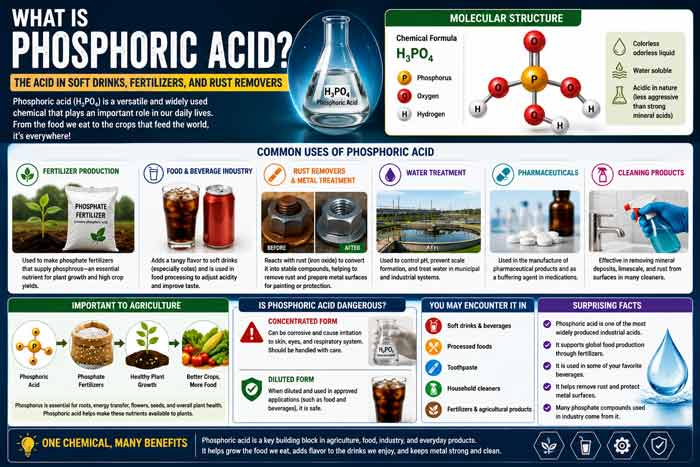
Although many people have never heard of it, phosphoric acid is found in a surprising number of products and industries.
It helps farmers grow crops, manufacturers produce fertilizers, food companies make soft drinks and certain beverages, and even homeowners remove rust from metal surfaces.
In fact, you may have consumed phosphoric acid without realizing it.
What makes phosphoric acid so useful is its versatility. It is strong enough to participate in important chemical reactions but generally less aggressive than some other industrial acids.
This balance makes it valuable in agriculture, manufacturing, food production, and countless other applications.
In this article, we’ll explore what phosphoric acid is, how it works, where it is found, and why it has become one of the world’s most important industrial chemicals.
What is Phosphoric Acid?
Phosphoric acid is a mineral acid that contains phosphorus, oxygen, and hydrogen.
Phosphoric Acid Chemical Formula
The chemical formula of phosphoric acid is H3PO4.
This means that a molecule of phosphoric acid contains:
- One phosphorus atom
- Four oxygen atoms
- Three hydrogen atoms.
At room temperature, phosphoric acid is typically:
- Colorless
- Odorless
- Acidic
- Water-soluble.
It may be found as a liquid solution or as a crystalline solid in its pure form.
Understanding the Molecular Structure of Phosphoric Acid
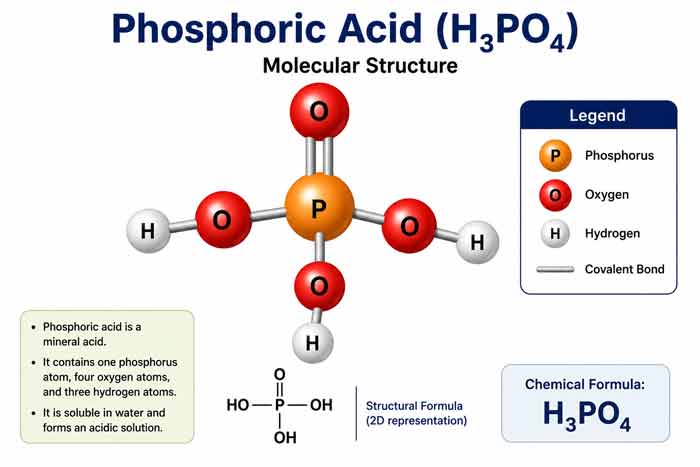
The properties of phosphoric acid are explainable by its molecular structure.
As stated earlier, phosphoric acid has the chemical formula H3PO4, with a molecule containing one phosphorus atom, four oxygen atoms, and three hydrogen atoms.
These atoms are arranged in a way that allows phosphoric acid to release hydrogen ions when dissolved in water, giving it its acidic properties.
Why the Structure Matters
The arrangement of atoms influences how phosphoric acid behaves.
Its molecular structure allows it to:
- Dissolve easily in water
- Participate in chemical reactions
- Form phosphate salts
- Support plant nutrition through fertilizers.
This combination of properties explains why phosphoric acid is useful in so many industries.
Properties of Phosphoric acid
Phosphoric acid exhibits physical and chemical properties that make it to be particularly useful in making certain products, such as soft drinks, fertilizers, and rust removers. These include:
Physical Properties of Phosphoric Acid
Several physical characteristics help make phosphoric acid practical for industrial and commercial use.
- Appearance: Pure phosphoric acid is generally colorless.
- Odor: It has little or no noticeable odor.
- Solubility: Phosphoric acid dissolves readily in water. This makes it easy to use in liquid formulations.
- Stability: Under normal storage conditions, phosphoric acid is relatively stable.
- Acidity: It is acidic, but generally less aggressive than strong mineral acids such as sulfuric acid. This moderate acidity contributes to its versatility.
Chemical Properties of Phosphoric Acid
The chemical behavior of phosphoric acid is what makes it especially valuable.
- It Acts as an Acid
When dissolved in water, phosphoric acid releases hydrogen ions. This gives solutions their acidic nature.
- It Forms Phosphate Salts
One of phosphoric acid’s most important reactions is the formation of phosphate salts.
These compounds are widely used in:
- Fertilizers
- Food additives
- Water treatment products
- Industrial processes.
- It Reacts With Bases
Like many acids, phosphoric acid reacts with bases to produce salts and water. This property is useful in manufacturing and chemical processing.
- It Reacts with Rust
Phosphoric acid can react with rust on metal surfaces and remove it.
This reaction helps convert rust into more stable compounds and is one reason phosphoric acid appears in some rust-removal products.
Why is Phosphoric Acid Important?
Phosphoric acid is important because it serves as a starting material for many products used around the world.
It is particularly important in:
- Fertilizer production
- Food processing
- Beverage manufacturing
- Metal treatment
- Cleaning products
- Pharmaceutical manufacturing.
Its widespread use makes it one of the most important phosphorus-containing chemicals in industry.
Uses of Phosphoric Acid
The following are important areas where phosphoric acid is used:
- Phosphoric Acid in Fertilizers
One of the most important uses of phosphoric acid is fertilizer production. In fact, much of the phosphoric acid produced worldwide ultimately supports agriculture.
Why Plants Need Phosphorus
Plants require phosphorus for:
- Root development
- Energy transfer
- Flower production
- Seed formation
- Overall growth.
Without sufficient phosphorus, crops may struggle to develop properly.
How Phosphoric Acid Helps
Phosphoric acid is used to manufacture phosphate fertilizers. These fertilizers supply phosphorus in forms that plants can absorb and use.
Because of this role, phosphoric acid helps support food production around the world.
- Phosphoric Acid in Food and Soft Drinks
Many people are surprised to learn that phosphoric acid is also used in certain foods and beverages.
Why is it added to Soft Drinks?
Phosphoric acid contributes a tangy, slightly sharp taste that helps balance sweetness. It is commonly associated with some cola-flavored beverages.
Food Processing Applications
Phosphoric acid may also be used in food manufacturing to:
- Adjust acidity
- Improve flavor balance
- Support product consistency.
Food-grade phosphoric acid is carefully regulated for these applications.
- Phosphoric Acid in Rust Removers
If you’ve ever seen a rust-removal product, there’s a good chance phosphoric acid was involved.
How it Works
Rust consists largely of iron oxides.
Phosphoric acid reacts with these compounds and helps transform them into more stable materials.
As a result:
- Rust can be reduced
- Surfaces can be cleaned
- Metal can be prepared for painting or treatment.
This makes phosphoric acid useful in maintenance and restoration work.
Other Common Uses of Phosphoric Acid
The versatility of phosphoric acid extends far beyond food and agriculture. It is also used in the following ways:
- Water Treatment
Phosphoric acid may be used in certain water-treatment applications.
- Pharmaceutical Manufacturing
Some pharmaceutical products involve phosphate compounds derived from phosphoric acid.
- Cleaning Products
Certain industrial and household cleaners use phosphoric acid because of its ability to dissolve mineral deposits and rust.
- Metal Processing
Phosphoric acid helps prepare and protect metal surfaces in some manufacturing operations.
Is Phosphoric Acid Dangerous?
Like many chemicals, phosphoric acid should be handled appropriately. The level of risk depends largely on concentration.
Concentrated Forms
Highly concentrated phosphoric acid can be corrosive and may cause irritation or damage upon contact.
Diluted Forms
When properly diluted and used in approved applications, phosphoric acid can be safely incorporated into products, such as beverages and food ingredients.
Why Concentration Matters
Many substances behave differently depending on concentration. Phosphoric acid is no exception.
The concentrated acid used in industrial processes is very different from the tiny amounts found in certain food products.
Common Myths about Phosphoric Acid
Here are common myth associated with phosphoric acid and their truth:
Myth #1: All Acids Are Extremely Dangerous
False.
Many acids are used safely every day when handled and formulated correctly.
Myth #2: Phosphoric Acid Exists Only in Factories
False.
It can also be found in some food products, beverages, and household products.
Myth #3: Acids Have No Useful Purpose
False.
Many important industries depend on acids, including agriculture, food production, and manufacturing.
Myth #4: Phosphoric Acid Is the Same as Battery Acid
False.
Battery acid typically refers to sulfuric acid, which is a different chemical with different properties.
Surprising Facts about Phosphoric Acid
These are amazing facts about phosphoric acid to enhance your knowledge-base:
- It is one of the world’s most important industrial acids.
- It helps produce fertilizers that support global agriculture.
- It is found in some cola beverages.
- It can help remove rust from metal surfaces.
- It plays a role in water treatment and manufacturing.
- Many phosphate compounds originate from phosphoric acid.
Why Phosphoric Acid Matters
Phosphoric acid may not be a household name, but its impact is enormous.
It helps:
- Support crop production
- Improve food manufacturing
- Treat metal surfaces
- Produce industrial materials
- Enable countless chemical processes
Without phosphoric acid, modern agriculture and many manufacturing industries would look very different.
Frequently Asked Questions (FAQs) about Phosphoric Acid
Here are commonly asked questions about phosphoric acid and their answers:
- What is phosphoric acid?
Phosphoric acid is a phosphorus-containing mineral acid widely used in fertilizers, food processing, beverages, rust removers, and industrial manufacturing.
Its chemical formula is: H3PO4
- Where is phosphoric acid found in everyday life?
Phosphoric acid can be found in:
- Some cola beverages
- Fertilizers
- Rust-removal products
- Certain cleaning products
- Food processing applications
- Industrial manufacturing processes.
- Why is phosphoric acid added to soft drinks?
Phosphoric acid helps provide a tangy, slightly acidic flavor that balances the sweetness of some soft drinks, particularly cola-flavored beverages.
- What is phosphoric acid used for in agriculture?
Phosphoric acid is used to manufacture phosphate fertilizers, which supply phosphorus—an essential nutrient that helps plants grow, develop roots, produce flowers, and form seeds.
- How does phosphoric acid remove rust?
Phosphoric acid reacts with iron oxide (rust) and converts it into more stable compounds. This helps in cleaning rusted surfaces and preparing metal for painting or further treatment.
- Is phosphoric acid the same as battery acid?
No. Battery acid is typically sulfuric acid, while phosphoric acid is a different chemical with different properties and uses. Sulfuric acid formula is H2SO4 while phosphoric acid formula is H3PO4.
- Is phosphoric acid dangerous?
The risk depends on concentration. Concentrated phosphoric acid can be corrosive and should be handled carefully. However, diluted food-grade phosphoric acid is used safely in approved food and beverage applications.
- Why is phosphorus important for plants?
Phosphorus helps plants:
- Develop strong roots
- Transfer energy
- Produce flowers and fruits
- Form seeds
- Grow properly.
This is why phosphate fertilizers are so important in agriculture.
- Does phosphoric acid have a smell?
Pure phosphoric acid is generally odorless or has very little noticeable odor, unlike some other industrial acids that produce strong fumes.
- Why is phosphoric acid considered important?
Phosphoric acid plays a major role in modern life. It helps support global food production through fertilizers, contributes to food and beverage manufacturing, assists in rust removal, and serves as a key ingredient in numerous industrial processes. Without it, agriculture and many manufacturing industries would be far less efficient.
Conclusion
Phosphoric acid is one of the most useful and versatile chemicals in the modern world. From helping farmers grow crops to contributing flavor to soft drinks and removing rust from metal surfaces, it plays a role in many aspects of daily life.
Its unique combination of chemical properties makes it valuable across agriculture, food production, manufacturing, and industrial processing.
Although most people rarely think about phosphoric acid, its influence can be found almost everywhere — from the food we eat to the products we use and the crops that help feed the world.
The next time you see a fertilizer bag, a rust remover, or even a bottle of cola, you’ll know that phosphoric acid may be quietly working behind the scenes.