
Most people have heard the term battery acid, but few know what it actually is or why it plays such an important role in everyday life.
Hidden inside car batteries, backup power systems, and industrial equipment, battery acid helps power devices that millions of people rely on every day.
Without it, your car might not start, emergency power systems could fail, and many forms of transportation and equipment would stop functioning.
Despite its importance, battery acid is often misunderstood.
Some people imagine it as a mysterious liquid capable of instantly dissolving anything it touches.
Others assume all batteries contain battery acid. The truth is more interesting.
Battery acid is a carefully formulated chemical solution that helps convert chemical energy into electrical energy.
In this article, we’ll explore what battery acid is, how it works, why batteries need it, and why this often-overlooked liquid remains one of the most important substances in modern technology.
What is Battery Acid?
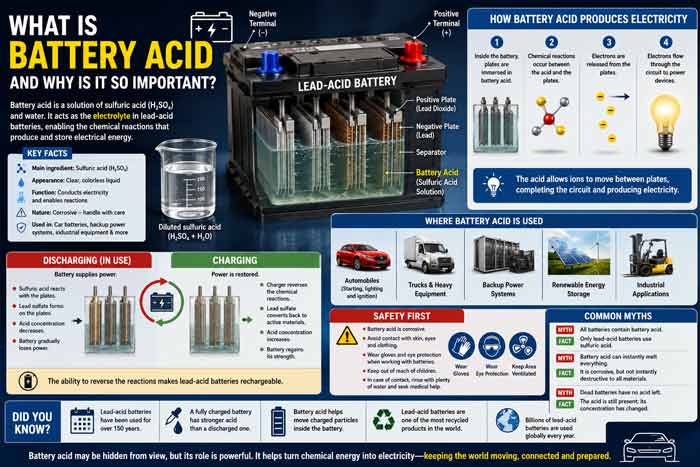
Battery acid is the liquid electrolyte found inside most traditional lead-acid batteries, such as those used in cars, trucks, motorcycles, backup power systems, and many industrial applications.
The main ingredient in battery acid is sulfuric acid.
Chemical Formula of Sulfuric Acid
The chemical or molecular formula of sulfuric acid is
H2SO4
This shows that a molecule of sulfuric acid is made up of two hydrogen atoms, one sulphur atom, and four oxygen atoms.
However, the liquid inside a battery is not pure sulfuric acid. Instead, sulfuric acid is mixed with water to create a solution that can safely and effectively conduct electrical charge.
What Does Battery Acid Look Like?
Battery acid is:
- Clear and colorless
- Liquid at room temperature
- Odorless under normal conditions
- Highly conductive
- Corrosive if mishandled.
Because it looks similar to water, battery acid should always be handled with caution.
Why is Sulfuric Acid Used as Battery Acid?
Sulfuric acid has several properties that make it ideal for batteries:
- It conducts electrical charge efficiently.
- It participates in chemical reactions that generate electricity.
- It is relatively stable when properly contained.
- It helps batteries deliver reliable power over long periods.
These properties have made sulfuric acid the preferred electrolyte in lead-acid batteries for more than a century.
Why Batteries Need Acid
To understand the role of battery acid, it helps to understand what a battery actually does.
A battery is essentially a device that converts chemical energy into electrical energy.
The electricity produced by a battery powers:
- Car starters
- Lights
- Electronics
- Emergency systems
- Various electrical devices.
Battery acid plays a crucial role in making this energy conversion possible.
The Role of the Electrolyte
The sulfuric acid solution acts as an electrolyte.
What is an Electrolyte?
An electrolyte is a substance that allows charged particles to move through a liquid.
Inside a battery, the electrolyte helps transport charged particles between the battery’s internal components.
Without this movement, electricity could not be generated.
How Battery Acid Produces Electricity
Inside a typical lead-acid battery are two types of plates:
Positive Plates:
Made primarily of lead dioxide.
Negative Plates:
Made primarily of lead.
These plates are submerged in battery acid.
The Chemical Reaction
When a battery is connected to a device, chemical reactions begin inside the battery.
The sulfuric acid reacts with the lead-based plates.
As these reactions occur:
- Electrons are released.
- Electrons flow through an external circuit.
- Electrical energy is produced.
This flow of electrons is what we recognize as electricity.
A Simple Analogy
Imagine a water wheel powered by flowing water.
The water provides the movement needed to turn the wheel.
Similarly, battery acid helps create the conditions that allow electrons to flow and produce electricity.
Without the acid, the chemical reactions would not occur efficiently.
What Happens When a Battery Discharges?
Every time you start your car or use electricity from a lead-acid battery, the battery begins to discharge.
During discharge:
- Sulfuric acid is consumed in chemical reactions.
- Lead sulfate forms on the plates.
- Electrical energy is produced.
As this process continues, the concentration of sulfuric acid gradually decreases.
In simple terms, the battery acid becomes weaker.
Why Batteries Eventually Go Flat
As more sulfuric acid participates in chemical reactions:
- Less active acid remains available.
- Electricity production slows.
- Battery voltage decreases.
Eventually, the battery can no longer provide enough power and needs recharging.
What Happens During Charging?
Rechargeable batteries have an important advantage.
Their chemical reactions can be reversed.
When a charger is connected:
- Electricity flows back into the battery.
- Lead sulfate is converted back into its original materials.
- Sulfuric acid concentration increases again.
The battery is essentially restored to a charged state.
This ability to reverse chemical reactions is what makes rechargeable batteries so useful.
Common Uses of Battery Acid
Battery acid is used in many applications beyond automobiles.
These include:
- Car Batteries
This is the most familiar use.
Battery acid helps provide the electricity needed to:
- Start engines
- Power lights
- Run onboard electronics.
- Trucks and Heavy Equipment
Construction machinery, agricultural equipment, and commercial vehicles often rely on large lead-acid batteries.
- Backup Power Systems
Hospitals, data centers, and emergency facilities use lead-acid batteries to provide power during outages.
- Renewable Energy Storage
Some solar and wind energy systems use lead-acid batteries to store electricity for later use.
- Industrial Applications
Battery acid plays a role in forklifts, telecommunications systems, and other industrial equipment.
Is Battery Acid Dangerous?
Battery acid is extremely useful, but it must be treated with respect.
Because it contains sulfuric acid, it can be corrosive.
Why it is Corrosive
Sulfuric acid can react with many materials, including:
- Metals
- Fabrics
- Skin
- Certain plastics.
Improper contact can cause damage.
Safety Precautions
When working around batteries, you should take the following precautions:
- Wear appropriate protective equipment.
- Avoid direct contact with battery acid.
- Keep batteries upright.
- Follow manufacturer safety instructions.
Most modern batteries are designed to safely contain the acid under normal conditions.
Common Myths about Battery Acid
Myth #1: Battery Acid Is Pure Acid
False.
Battery acid is actually a mixture of sulfuric acid and water.
Myth #2: All Batteries Contain Battery Acid
False.
Many modern batteries, including lithium-ion batteries used in phones and laptops, do not contain sulfuric acid.
Myth #3: Battery Acid Can Instantly Dissolve Anything
False.
While battery acid is corrosive, it does not instantly dissolve every material it touches.
Myth #4: Dead Batteries Have No Acid Left
False.
A discharged battery still contains acid.
The concentration simply changes as chemical reactions occur.
Surprising Facts about Battery Acid
The following are facts about sulfuric acid to boost your knowledge-base
- Battery acid is mostly a mixture of sulfuric acid and water.
- Lead-acid batteries have been used for over 150 years.
- The acid becomes weaker as a battery discharges.
- Battery acid helps move charged particles inside the battery.
- Many backup power systems still rely on lead-acid battery technology.
- Sulfuric acid is one of the most widely produced industrial chemicals in the world.
Frequently Asked Questions (FAQs) About Battery Acid
These are common questions people usually ask about battery acid and their answers:
- What is battery acid?
Battery acid is a solution of sulfuric acid and water used in lead-acid batteries. It acts as an electrolyte, helping chemical reactions produce electricity.
The chemical formula of sulfuric acid is: H2SO4
- Why is battery acid important?
Battery acid enables the chemical reactions that allow a battery to generate and store electrical energy. Without it, most lead-acid batteries would not function.
- What does battery acid look like?
Battery acid is usually a clear, colorless liquid. Because it resembles water, it can be dangerous if handled carelessly.
- Do all batteries contain battery acid?
No. Battery acid is mainly found in lead-acid batteries, such as those used in cars. Many modern batteries, including lithium-ion batteries in phones and laptops, do not contain sulfuric acid.
- How does battery acid produce electricity?
Battery acid reacts with lead-based plates inside a battery. These reactions release electrons, creating an electrical current that can power devices.
- Is battery acid dangerous?
Yes. Battery acid is corrosive and can damage skin, eyes, clothing, and certain materials. It should always be handled carefully and according to safety guidelines.
- Why does battery acid become weaker over time?
As a battery discharges, sulfuric acid participates in chemical reactions and gradually becomes less concentrated. This reduces the battery’s ability to produce electricity until it is recharged.
- Can battery acid freeze?
Yes. The freezing point depends on the acid concentration. A fully charged battery is less likely to freeze than a discharged battery because its acid concentration is higher.
- Can a battery work without acid?
Traditional lead-acid batteries cannot. The acid acts as the electrolyte that allows charged particles to move and chemical reactions to occur.
- Why are lead-acid batteries still used today?
Despite newer battery technologies, lead-acid batteries remain popular because they are:
- Reliable
- Relatively inexpensive
- Durable
- Easy to recycle
- Capable of delivering high starting power for vehicles.
This combination of performance and affordability keeps them widely used in cars, backup power systems, and industrial equipment.
Conclusion
Battery acid is much more than a mysterious liquid hidden inside a battery. It is a carefully designed mixture of sulfuric acid and water that plays a vital role in converting chemical energy into electrical energy.
By allowing charged particles to move and participate in electrochemical reactions, battery acid makes it possible for lead-acid batteries to power vehicles, equipment, emergency systems, and countless other technologies.
While it must be handled safely due to its corrosive nature, its importance to modern society cannot be overstated.
The next time your car starts with the turn of a key or a backup battery keeps essential equipment running during a power outage, remember that battery acid is helping make it all possible.